Monthly Archives: October 2022

Online Dharma Talks

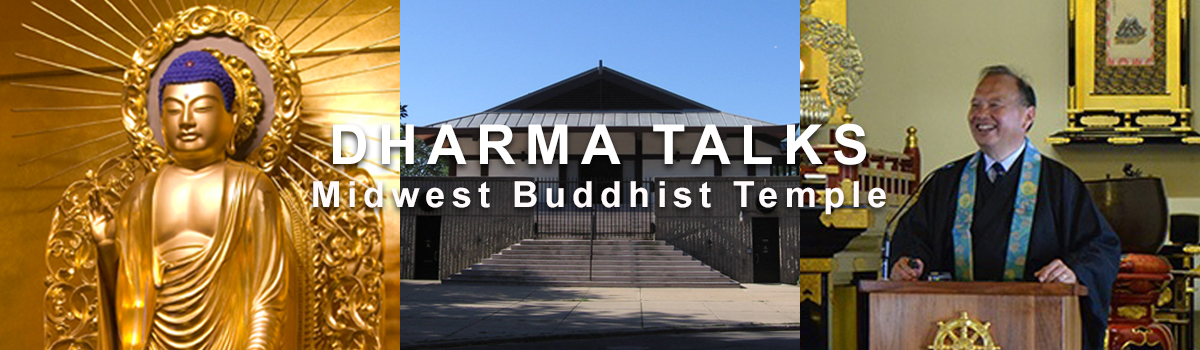
DHARMA TALKS

Welcome to our Online Dharma Talks page. “Dharma” translates to “teachings of the Buddha”. Each week we post the Dharma message delivered by our resident minister or a guest speaker who provide insights about the Buddha’s teachings. Recordings are saved in video and podcast formats so follow one of the links below for the format of your choice.

About Dharma Talks: Any ideas and opinions expressed in these talks are those of the individual speakers. These recordings are for personal listening only and no other use is authorized.

Browse MBT Video Archive to find recent Dharma messages in video format.

If you prefer the podcast format you can browse the MBT Podcast Archive.

Please consider making a donation to MBT – Thank you.

date published:
October 17th, 2022|

Welcome to the Midwest Buddhist Temple

WELCOME! “Come as you are and stay awhile”

In this brochure find information about MBT and our weekly services.

Welcome

to the

MIDWEST BUDDHIST TEMPLE

click to download brochure

Sunday Service at 10:30am

Who we are:

The Midwest Buddhist Temple (MBT) began in 1944 organized by Japanese Americans relocating to Chicago after imprisonment in the American WWII concentration camps. As our participation in the community has grown, so has the diversity of our membership.

We are a community of Jodo Shinshu Buddhists which is a Pure Land tradition in the Mahayana School of Buddhism. What this means is that we are concerned not only with our own lives but for the lives of others.

We understand that we are interconnected with all beings in oneness. This does not deny our individuality, yet what we do affects others as we are a collective part of this world. We realize our lives are the result of causes and conditions and the actions of others which gives us a profound sense of gratitude.

We practice a religion that teaches us to be truly human. By observing the universe, we come to understand our place in the world. In short, Buddhism shows us that our ego, our image of ourselves, is false. By letting go of our ego, we understand that we are part of a greater whole, not the center.

Our tradition is for the ordinary person and does not require us to become a monk or sit

for hours in deep meditation. It is through deep listening that the Dharma penetrates into our hearts. From our life experiences with others, the Dharma can illuminate even the darkest corners of our ego self.

As with all Buddhist traditions, enlightenment or awakening is our goal. Shin Buddhism teaches how ordinary people can find their own path to enlightenment. It gives us a unique path for everyone to discover awakening.

Who is welcome: You are!

“Come as you are and stay awhile”

Come as you are” means there is no judgement about who or where you are from, your beliefs, age, class, race, sexual identity, gender or any other basis. There is no exclusivity in Jodo Shinshu. This radical equality is an extremely important message welcoming all those who want to hear the Buddha-Dharma and experience the teaching of non-discrimination of our founder, Shinran Shonin. It is a teaching available to all. Amida Buddha is said to have the “Wisdom of Non-Discrimination.” This is manifested in the Great Compassion that embraces all beings.

To “stay awhile” is listening, observing, participating and reflecting, which are important parts of the tradition. This describes one of the primary practices of

Jodo Shinshu, that of “deep listening.” To deeply hear the Dharma or the Buddhist teachings allows us to better understand ourselves and our world.

What you will experience at MBT:

A Sunday service is an opportunity to encounter the Dharma, the Buddha’s teachings. We sit in pews, sing songs, chant sutras, participate in readings and hear a message shared by our minister. We welcome families and have a Dharma School for children. Casual attire is fine.

We encounter the Dharma not only through the messages shared in the service, but from the experience of engaging with others during the many activities at MBT. The Jodo Shinshu tradition emphasizes “ondobo/ondogyo” meaning fellow travelers on the path. The significance is that we are part of a Sangha or community of followers.

Items on the altar:

(Naijin/Inner sanctuary)

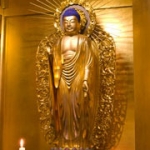
Amida Buddha Statue:TempleArtifacts Amida Statue
Jodo Shinshu is a Pure Land tradition. The Pure Land is the land where Amida Buddha resides. Amida is the Buddha of Infinite Light and Life or Wisdom and Compassion and is the golden statue that is revered (Gohonzon). Amida Buddha is not a person or a divine omnipotent being who grants us things if we meet certain conditions.

Instead, Amida Buddha is the dynamic reality of infinite wisdom and compassion. Amida is formless but we give Amida anthropomorphic features to help us understand our relationship to ultimate reality. In other words, Amida is the embodiment of the principle of infinite wisdom unfolding as compassion – the way this world actually is but difficult to see because of our blind passions, our egocentric self.

Ornaments:
The ornaments in the Naijin (inner sanctuary) are representations of the Pure Land. It is usually not thought of as an actual place but a purified sphere of influence or realization for Amida Buddha. Each has meaning, adding to the environment for us to attain awakening.

Meaning of the rituals:
Worshipers place incense in the burner (oshoko), place their palms together (gassho), encircling their hands with their mindfulness beads (nenju), and recite “Namo Amida Butsu.”

– Incense Offering: incense represents the transiency of life. The smell purifies the air and represents the Dharma. The candle is the light of wisdom of the Buddha. Flowers symbolize impermanence and the changing existence of nature.

– Gassho: is an expression of reverence and gratitude.

– Nenju: encircling the hands with a nenju represents oneness.

– Namo Amida Butsu: is translated as “I take refuge in the Buddha.” It is not a meditation or practice to attain enlightenment but an expression of gratitude for having received the True Entrusting Mind of the Buddha. It is called the Nembutsu which means to “think on” or the “recitation of” the Buddha’s name.

Can I participate in the rituals?

You are welcome and encouraged to participate in any rituals being done by others and we can help you with any questions. If you are not comfortable, there is no requirement to do so. You don’t have to be a member, go through special training or do things perfectly to participate in our gatherings. The act of learning the process and going through the ritual is in itself mindfulness of the Buddha and our lives. We only ask that you are respectful.

Want more details and information?

Please ask us how you can learn more about the temple and our tradition. There are opportunities to be a part of our Sangha in different ways to fit your time and comfort level.

October 15th, 2022|

Tell me more about the Border land

Q-60pxI heard there is a Border Land. Is this a part of the Pure Land? What are some of the reasons that someone might go there?

A-60pxYes, there is a Border Land in most traditional Pure Land Buddhist schools/ sects. It refers to someone who dies and is not yet determined to enter the Pure Land due to incomplete practice. It is the Border Land between this physical world and the Spiritual World of the Pure Land.

For Shin Buddhists (Jodo Shinshu), as taught by Shinran Shonin, our founder, the Border Land does not really apply. Due to the inexhaustible (or infinite) Storehouse of Merit accumulated by Dharmakara Bodhisattva’s completion of Vows and becoming Amida Buddha, everyone is Born in the Pure Land.

Thus, we know that Amida’s Vow is able to overcome all of our human limitations. This is known as Vow Power or Other Power, which makes Shin Buddhism unique. In Shin Buddhism, everyone is Born in the Pure Land, in this life or at death. There are no exceptions because of Amida’s Vow.

Shin Buddhism is not for the “chosen few,” which is common for most religions. Rather, Shin Buddhism is for the chosen all—an odd term, but means there are no exceptions for Birth in the Pure Land.

The Pure Land is the realm of spiritual existence beyond this world. It is a realm or world in which a Bodhisattva postpones their own Enlightenment and continues to assist others with a heart of Compassion.

Gassho (with palms together), Rev. Ron

October 10th, 2022|
Go to Top