Yearly Archives: 2021

Buddhist thinking about impure thoughts, evil

Q-60pxWhat does Buddhism say about impure thoughts and immoral impulses? In other religions it is looked at as temptation from evil spirits and such, but how does Buddhism explain the root cause behind the temptation of sin and what can be done to help ourselves when tempted? Is there such thing as a naturally evil person?

A-60px

Second question first….. in Shin Buddhism (but not all schools of Buddhism), there is no such thing as a naturally evil person…. everyone is evil, so it is only a matter of degree.

Impure thoughts and immoral impulses….an interesting question. Certainly from a Buddhist point of view, this is not “sin” since there is no sin in Buddhism (sin as understood as breaking commandants or rules). The bottom line is “we are responsible for our thoughts, words and actions.” Thus, we have to use our judgment, knowledge, wisdom and experience to handle any thoughts (pure or impure) we might have, and then decide our words and our actions.

As Buddhists, we cannot judge other people’s actions (being nonjudgmental) and we cannot know the whole situation. We can only judge ourselves and use our tools (judgment, knowledge, wisdom and experience) to determine our thoughts and then, maybe, our actions.

Thus, our course of action when “being tempted” is to take responsibility for our actions.

Gassho (with palms together), Rev. Ron
December 24th, 2021|

THANK YOU from Fill the Gap

As a way of showing our appreciation for your support please enjoy this new film celebrating Ginza Holiday. You’ll find new interviews, pictures, video clips and even original music. We hope you enjoy GINZA MEMORIES!

If you want to see more you can view 2020 Virtual Ginza Holiday.

THERE’S STILL TIME TO MAKE A DONATION!

For more info about PayPal or to donate by check or ZELLE see the FAQ below.

SCROLL

SCROLL

SCROLL

SCROLL

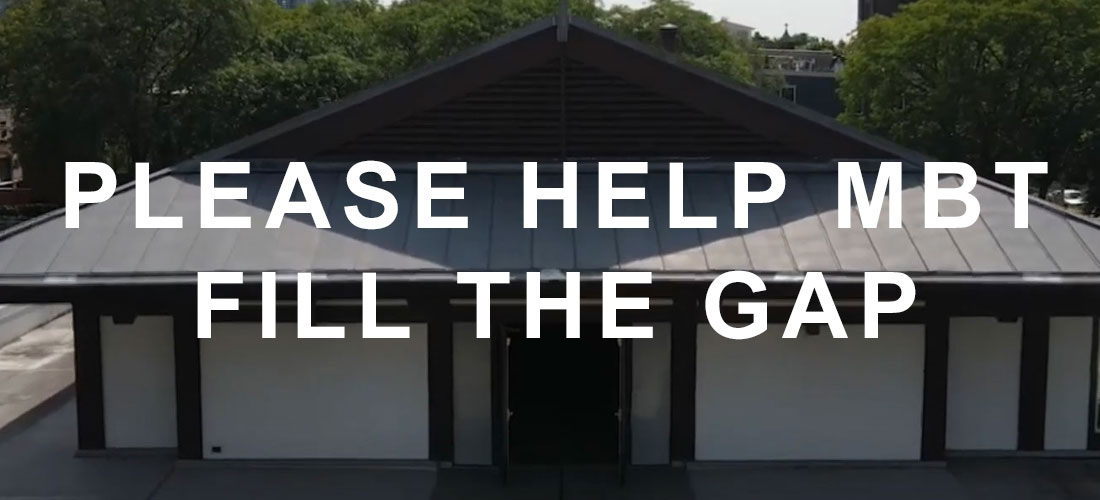
HELP MBT
FILL THE GAP

INTRODUCTION

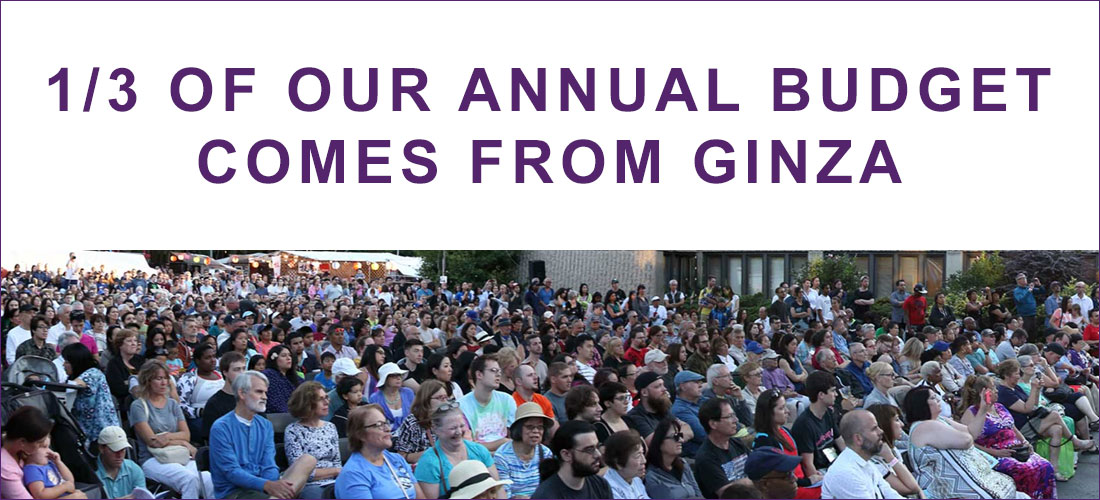
We are appealing to you to help us close our budget gap. Ginza Holiday represents 1/3 of our annual operating budget but we’ve had to cancel Ginza not once but for 2 consecutive years! Thanks to sound fiscal management MBT’s long-term financial state remains strong – but missing Ginza for 2 years in a row has put a significant gap in our annual budget. Throughout our Fill the Gap campaign we’ll share information about what it takes to keep MBT going. Take a moment and read the letter from the MBT Board. Please donate generously and help MBT Fill the Gap. 

HOW MUCH SHOULD YOU GIVE?

The amount you give is a personal decision and any amount will be greatly appreciated. That said, here are a couple of suggestions that may help you decide:

  • Have a family discussion about what role MBT plays in your lives: a place to hear the teachings of Buddhism, for children to participate in Dharma School, to celebrate special occasions, to honor those who have passed, to gather as a community, or all of the above.
  • Then think about some things you spend on which may help you prioritize your donation. For instance; during a normal Ginza Holiday weekend a family may spend up to $200 for Chicken Teriyaki dinners, beverages, udon, sushi and maybe a special craft or two. A family going to a baseball game will easily spend $300 or more. Ordering take-home dinner could cost $50 or more but if you order out just 1 fewer times per month that would be $50 x 12 = $600! See if there’s room in your routine spending to help MBT Fill the Gap.

THANKS!

Fill the Gap is now over and we thank you for your generosity. 

SHARE THIS MESSAGE

Please help spread the word to your family or friends of MBT. Email a link to this webpage, post the link to your Facebook network, or forward the Fill the Gap emails that you receive. Encourage your network to participate.

Thank you for your donation, thank you for your help!

Help MBT Fill the Gap

For more info about PayPal or to donate by check or ZELLE see the FAQ below.

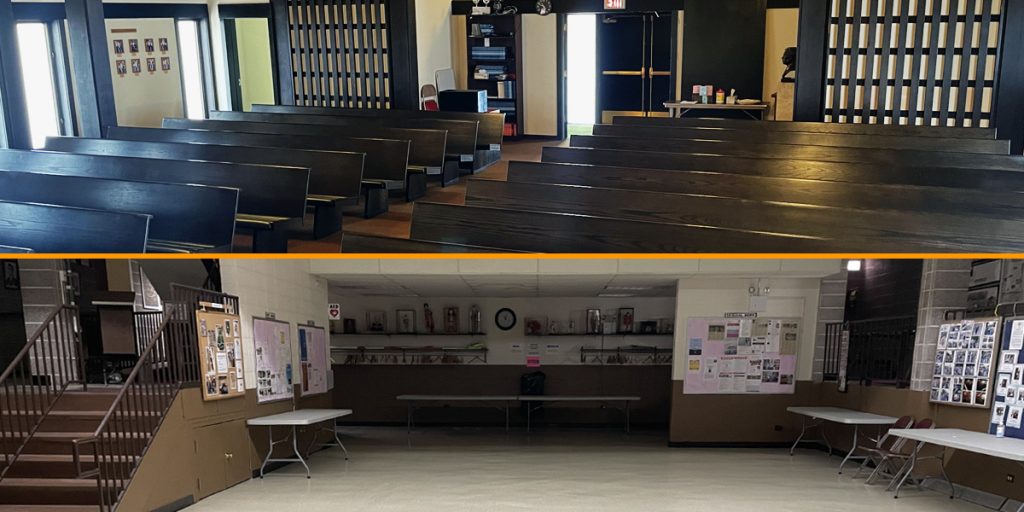
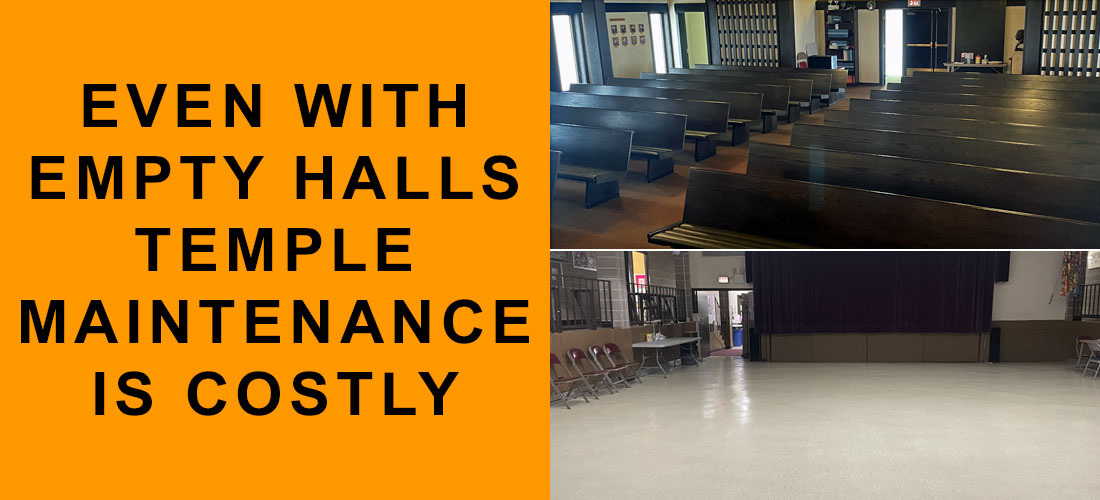
OUR HALLS ARE EMPTY
BUT TEMPLE MAINTENANCE IS STILL NEEDED

MANY THANKS TO OUR VOLUNTEERS

Like any large building, MBT requires a tremendous amount of routine maintenance just to keep things in good shape. And we are lucky to have a group of dedicated volunteers who give up their free time to tend to our gardens, keep our kitchen organized, or make all manner of repairs and improvements from electrical, to plumbing, to carpentry, and even our telephones and security system. These wonderful volunteers (you know who you are!) have helped MBT keep maintenance expenses at a reasonable level and they have not taken a break even during the pandemic. Thank you to our volunteers!

WHEN PROFESSIONAL CONTRACTORS ARE REQUIRED

Despite the efforts of volunteers, some maintenance or repair tasks require professional contractors. Of course, these major tasks are planned in advanced and are a part of our annual budget. The MBT Board prudently continues these projects as required (forgoing maintenance could lead to much larger repair costs down the road). Here is a partial list of maintenance or repair projects. Please note: these are not all immediate – some are routine annual efforts, some are planned to start soon, some are on a longer time-line but they all have one thing in common – they all cost money.

  • Major landscaping & Legacy Garden maintenance
  • Elevator and chair-lift maintenance
  • Roof evaluation and repair
  • Heating/Air Conditioner maintenance
  • Sidewalk Replacement
  • Window repair or replacement
  • Major caulking & weatherproofing
  • Post Covid-19 physical improvements (if required)

Your donation to Fill the Gap can help MBT with these maintenances expenses. Thank you!

Help MBT Fill the Gap

For more info about PayPal or to donate by check or ZELLE see the FAQ below.

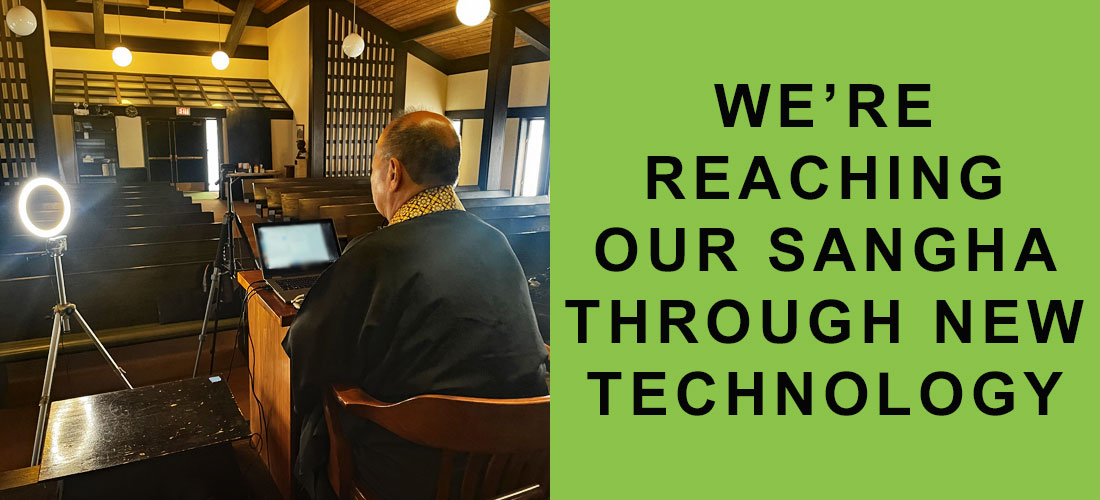
WE’RE REACHING THE SANGHA
THROUGH NEW TECHNOLOGY

REV RON PIONEERS VIRTUAL SERVICES

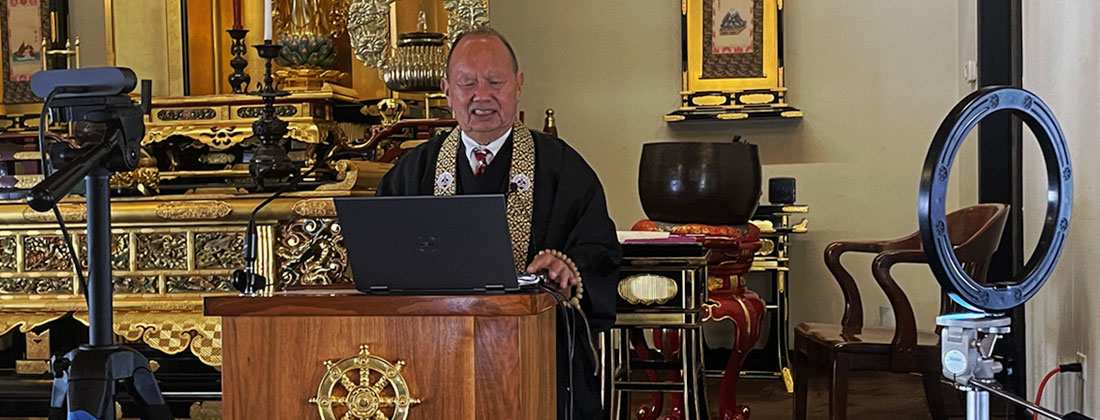
In the early days of the pandemic, when MBT had to close its doors, Rev. Ron decided that the Sangha and many others would benefit from a weekly video Dharma Message. He further decided that streaming his message “live” from the MBT Naijin would give people a sense of normalcy and comfort during chaotic times. He was right and we are grateful for his leadership. Since March of 2020 Rev. Miyamura has streamed over 75 Dharma Messages to Sangha members and friends of MBT via Facebook Live!  The technology he used has evolved over the past 20 months starting with his cell phone to a laptop with a webcam and a light ring. Rev. Ron would be the first to tell you that he had some help from a small group of volunteers to assist with organizing services, running ZOOM sessions and to chase down technical issues. Much appreciation to Rev. Ron and his volunteers!

VIDEO STREAMING IS HERE TO STAY

Thanks to Rev. Ron’s pioneering efforts we realized that video broadcasting significantly expands the reach of weekly Dharma Messages and creates new possibilities for outreach. Over the year of livestreaming services we experimented with ZOOM which allowed other speakers, like Rev. Tsuchiya or our own Minister’s Assistants, to participate in services from their homes. Also, during lockdown MBT offered a few “virtual” memorial services where families were able to participate from anywhere in the country or anywhere around the world! We realized that even after the Temple reopens for in-person services, livestreaming and video conferencing systems have a permanent place in MBT’s offerings.

BUT UPGRADES WERE REQUIRED

However, until recently our internal network at MBT was in such poor shape that Rev. Ron often had to use his personal cell phone just to get an internet connection in order to livestream Sunday Service. With the Board’s approval we recently upgraded our entire WiFi network resulting in a 5-fold increase in speed with much improved stability, security, and capacity for expansion. While the WiFi upgrade was expensive, costing several thousands of dollars, it was a necessary investment in the temple’s current and future outreach capabilities.

Your donation to Fill the Gap can help offset the cost of our WiFi upgrade. Thank you.

Help MBT Fill the Gap

For more info about PayPal or to donate by check or ZELLE see the FAQ below.

Fill the Gap – FAQ

Why is this needed? Like many non-profit organizations MBT relies on donations and fundraising to make up our annual budget. Of course the pandemic has forced us to cancel our biggest fundraiser, Ginza Holiday, for the second year in a row. We have taken prudent steps to reduce expenses and while MBT continues to have a good financial foundation, missing Ginza over 2 years has created a gap in our budget. Donations raised by this campaign will go directly to reducing that gap.

Is this the same thing as the Annual Pledge Drive? No. We are so grateful for all the Sangha members who submit their “Pledge” each year and our annual Pledge Drive will continue. “Fill the Gap” is a direct appeal to help MBT during these extraordinary times of the Covid-19 pandemic.

How much should I give? We’ve presented some “food for thought” about donations but in the end the amount you give is up to you. Please know that all donations, large or small, will be accepted with the same level of gratitude. Thank you!

A note about PayPal:  The DONATE NOW button will take you to PayPal. While PayPal is very convenient for collecting donations by credit card it also deducts a processing fee from each donation. PayPal now offers donors the option to increase their donation by a small amount to cover the processing fee thus insuring MBT will receive the full donation amount intended. You will see this option as you complete your PayPal transaction. This is optional and is up to each donor.

Can I donate with ZELLE? Yes. If your bank supports the ZELLE payment system then you can electronically send your donation directly to MBT’s bank account. This is a secure bank-to-bank funds transfer and the best part is there are no fees involved. Check with your bank to see if it supports ZELLE (most banks do) and then all you need is our special email address: giving@mbtchicago.org. NOTE: If you use Zelle please put your email address in the memo area when you create the donation. 

Can I give by check? Of course! Make your check out to “Midwest Buddhist Temple” (on the memo line write “Fill the Gap”) and mail it to:

Midwest Buddhist Temple
435 W. Menomonee Street
Chicago, Illinois 60614

Is MBT is a Non-Profit?: Yes, the Midwest Buddhist Temple is a 501(c)(3) non-profit organization.

WITH OUR DEEPEST GRATITUDE – THANK YOU

December 17th, 2021|

Do Buddhists believe in a supreme force?

Q-60pxIs there a supreme force, power or being?

A-60px

No, in Buddhist beliefs and teachings, there is not a supreme force, power or being in the sense of a Supreme creator, Supreme judge.

But, we do acknowledge an external power (or force, but not a being) that is beyond human understanding. This external power is in the spiritual world and can come to us limited human beings when we can let go of the ego-self. This is a force or power that guides us to wisdom and compassion because this force is Wisdom and Compassion itself.

Gassho (with palms together), Rev. Ron

November 28th, 2021|

What are differences between branches?

Q-60pxAre there any doctrinal differences between the Nishi Honganji and Higashi Honganji branches of Jōdo Shinshū?

A-60px

Simple answer, no.

There are more than 10 branches of Shin Buddhism— the largest are Jodo Shinshu Hongwanji-ha (aka Nishi Hongwanji) and Shinshu Ohtani-ha (aka Higashi Hongwanji).

They split in 1603, as both a political ploy by the new shogun (Tokugawa, Ieyasu) and by a family feud between brothers as who should be the monshu (abbot).

By doctrine, there is no difference in that the lineage of Shinran and monshus (including Rennyo, the great reformer and organizer) remained the same.

Since that time, there have been efforts to show the superiority of one branch or the other, and subtle changes, like the title of things chanted. For example, Nishi Honganji uses San Butsu Ge, and Higashi Honganji uses Tan Butsu Ge—the same words with just a different pronunciation.

In more recent times, say since the Meiji Restoration in 1868, the modernization of Japan has also created some subtle differences. First, Ryukoku University (Nishi) and Ohtani University (Higashi) have been in academic competition.

And maybe in the last 50 years, there have been more subtle differences in what part of the doctrine is emphasized.

Gassho (with palms together), Rev. Ron

November 20th, 2021|

Is life governed by destiny?

Q-60pxDoes Shin Buddhism teach that life is governed by destiny?

A-60px

Shin Buddhism is part of general Mahayana Buddhism, and life is “governed” by Karma, which is not “destiny.” Everything in this world happens for a reason because everything is inter-connected. There are causes and conditions that lead to a certain result, and that result is part of the causes or conditions for other things.

Karma has two aspects, a passive aspect and an active aspect. The passive aspect is what we are born with, our height, eye color, hair color, etc., are inherited from our parents, and there is nothing we can do about it. We are born with it. But, what happens in life is determined by the choices we make. Life certainly looks more like an accident than destiny.

And, yes, everything happens for a reason. We just might not be able to see nor understand those reasons. The causes and conditions come together to cause something to happen. Most of the time, we don’t know why.

All the events—from the time we were born—leads us to this moment. We cannot possibly know all the causes and conditions that brought us to this moment. The hidden causes and conditions are so buried that we cannot know everything. We just have to assume the rains came so the crops could grow in 1946, so that when I was born there was enough food to eat. It is related and inter-related, but we cannot always see the connections.

Gassho (with palms together), Rev. Ron

October 4th, 2021|

Can I attend services with service dog?

Q-60pxI sincerely want to learn more about Buddhism. I am a practiced meditator of many years—particularly mindfulness meditation. Thusly, vipassana is of great interest to me. I would like to expand my spiritual journey. I’ve been coming across a blockage toward that end, however, with regards to being welcomed with my trained and medical service dog. Although he is small enough to sit on my lap, trained to neither bark, socialize or ever leave my side, nobody has accepted the opportunity to experience this for themselves. I hope against hope that your temple will be the exception.

A-60px

You and your certified service dog are welcome to services and activities of the Midwest Buddhist Temple.

We are a Shin Buddhist Temple (Jodo Shinshu in Japanese), and we certainly are not in the vipassana tradition. Our roots are in Japanese Pure Land Buddhism, which has a “Path of No Path” in the sense that we do not have a physical practice (path). Rather, we are ordinary people, living ordinary lives and traveling together as “fellow travelers” to encounter a spiritual path that is profoundly ordinary.

We do have Zen Shin mediation, which is a hybrid meditation-type service of Soto Zen, mindfulness and quiet introspection. These sessions are held at 8:30 am Sundays and at 6 pm Wednesdays.

Our Family Service is open to all and are held at 10:30 am Sundays.

Gassho (with palms together), Rev. Ron

August 29th, 2021|

Following the Eightfold Path, Six Paramitas

Q-60pxDo Shin Buddhists use the Eightfold Path and the Six Paramitas as a guideline in daily life? Can you explain how they are used a little bit.

A-60px

For the most part, Shin Buddhists do not try to follow the Eightfold Path in a strict sense.

We acknowledge that this is part of the basic Teaching of the Buddha, but the Eightfold Path is almost impossible to follow as a limited human being. Instead, we hold it as the ideal.

As Mahayana Buddhists, we try to follow the Six Paramitas. These are guidelines for daily living. But, again, we know the Six Paramitas are almost impossible to follow as limited human beings. But we try.

For example, Dana or Selfless- Giving is the first Paramita. We know it is good to give, and we want to give of ourselves (money, time, energy, etc.). But we also know that we are limited human beings, so we want to be acknowledged when we make a donation, we want a thank-you card or a tax letter for the donations we make.

In reality, we should be able to give selflessly, without expecting anything in return— to give for the sake of giving. That is the ideal.

We also have to be aware of the other end: to receive. To receive without needing to even say thank you, but to receive with heartfelt gratitude. Again that is the ideal.

Gassho (with palms together), Rev. Ron
August 6th, 2021|

Shin Buddhist ministers are teachers who can marry

Q-60pxAre you a monk?

A-60pxNo, I am not a monk—if you consider a monk being a celibate male who is ordained.

Our tradition, Jodo Shinshu (Shin Buddhism), is the first sect/school of Buddhism to have a married clergy. Shin Buddhism came out of the Pure Land School of Mahayana Buddhism, which started in Japan.

Our founder, Shinran Shonin, considered himself as neither monk nor layman. He saw a path of “ordinary people” (who were considered “householders,” i.e., married, with family and jobs) without distinction of being male or female, monk or layman, rich or poor, educated or illiterate. Our temples are organized in a congregational style, with a minister (as teacher and religious leader); with members; and, here in America, we adopted the Sunday service format of gathering, and thus, we have “Sunday Family Services.”

Here in America, the early pioneers who brought Japanese Shin Buddhism to this country, facing racial and religious discrimination, translated Kaikyoshi (the title of ordination and certification that I hold) to be “minister” and started to use the title “Reverend” so as not to be controversial nor noticed. Thus, I am often just called “Rev. Ron.”

Gassho (with palms together), Rev. Ron

July 7th, 2021|

2021 Hanamatsuri Service – Video

HANAMATSURI 2021

Cleveland Buddhist Temple, Twin Cities Buddhist Sangha, and Midwest Buddhist Temple 

Recently three temples, Cleveland Buddhist Temple, Twin Cities Buddhist Sangha, and Midwest Buddhist Temple, gathered virtually to celebrate Hanamatsuri. The Dharma School children worked hard to produce their socially distanced musical rendition of the song “In Lumbini’s Garden” and a creative narration of “The Life of the Buddha.” Under the guidance of their teachers, Jennifer Toguri, Elaine Miyamura, Chiemi Onikura Bly and the technical support of Kyle Tsuchiya, the entertaining videos were shared during the service. There were also music and chanting collaborations to make this service a unique and meaningful way to share the Dharma across temples. Dharma messages were shared for children and adults by Assistant Minister Rev. Chiemi Onikura Bly of the Twin Cities Sangha and Minister’s Assistant Joy Zavala of MBT. Please enjoy the video of the full service.

(If you would like to view more Dharma Talks visit our Online Dharma Talks Page)

date posted:

July 2nd, 2021|

How does political activism, Buddhism co-exist?

Q-60pxWhat are the political implications of Buddhism? In an age where politics is such a big part of our lives, and there are so many issues that cause pain and suffering, should we be active and engaged in the political process? Or would this put us in danger of us vs. them divisive thinking? When some actively want to harm others, are we obligated to try and stop them?

A-60pxThe political position of Buddhism has always been to get along with the local government. It was viewed as “Sutra and King” meaning that Sutra refers to the Teaching of the Buddha, and King refers to the government (back in those days, each area was a kingdom, ruled by a king). It was assumed that Buddhists got along with the king and the king, in turn, was kind to Buddhists. It is an acknowledgement that we live in this world together and cooperation was the best path.

Today, in America, this means to acknowledge the separation of church and state.

As for these times when politics are such a big part of our lives, yes, we should be engaged in politics.

We should encourage our leaders to follow the ideas of Buddhism. Mainly, this would mean, to follow a path of peace, to encourage harmony in society so that people are happy, and to care for the wellbeing of all living in our country/kingdom.

And when our leaders cannot follow the principles of Buddhism, we have the responsibility to change our leaders so that peace and harmony can guide our country and thus encourage the spread of Buddhism. Today, in America, it means to vote.

There is always danger when there are people who disagree with us. However, there are peaceful ways to confront those who disagree. If we choose a path of peacefulness and nonviolence, in the long run, we will prevail.

When there is violence and harm being done, we are obligated to stop the people doing the violence and harm in nonviolent ways. Today, in America, this could mean peaceful protest—not with rioting and rock throwing.

Gassho (with palms together), Rev. Ron
June 24th, 2021|

Shin Buddhist ministers are teachers who can marry

Q-60pxAre you a monk?

A-60pxNo, I am not a monk—if you consider a monk being a celibate male who is ordained.

Our tradition, Jodo Shinshu (Shin Buddhism), is the first sect/school of Buddhism to have a married clergy. Shin Buddhism came out of the Pure Land School of Mahayana Buddhism, which started in Japan. Our founder, Shinran Shonin, considered himself as neither monk nor layman. He saw a path of “ordinary people” (who were considered “householders,” i.e., married, with family and jobs) without distinction of being male or female, monk or layman, rich or poor, educated or illiterate.

Our temples are organized in a congregational style, with a minister (as teacher and religious leader); with members; and, here in America, we adopted the Sunday service format of gathering, and thus, we have “Sunday Family Services.”

Here in America, the early pioneers who brought Japanese Shin Buddhism to this country, facing racial and religious discrimination, translated Kaikyoshi (the title of ordination and certification that I hold) to be “minister” and started to use the title “Reverend” so as not to be controversial nor noticed. Thus, I am often just called “Rev. Ron.”

Gassho (with palms together), Rev. Ron
May 24th, 2021|

Chanting is part of Buddhism

Q-60pxWhy is there chanting during meditation?

A-60pxSlightly the wrong question… chanting is one kind of meditation. Meditation is not just sitting meditation, and even with sitting meditation, there is usually a breathing discipline along with other disciplines of posture, direction, duration, etc.

Chanting is part of Buddhism.

Buddhism started as an oral tradition (with no written language at the time). Thus, repeating the Teachings orally was one of the ways to pass them from one person to the next.

Currently, every Buddhist sect or school would chant part of the Sutras (words of the Buddha) as part of any religious service.

Gassho (with palms together), Rev. Ron
April 24th, 2021|

Choosing Boddhisatva or Buddha?

Q-60pxIf you had the choice, would you be Bodhisattva or become a Buddha? For what reason do you choose this?

A-60pxAs a Mahayana Buddhist, one always chooses to wish to become a Bodhisattva. In reality, it is impossible to become a Buddha with all the mixed messages we get in this world.

So, to aspire to be a Bodhisattva is what is possible. And one would be motivated by Compassion to help others because we live in society.

There is an old saying which rings true: ”If you want to go fast, go alone. But if you want to go far, go together.” As a Shin Buddhist, we all want to go far, so we go together as a Sangha (our group of fellow travelers).

Gassho (with palms together), Rev. Ron

March 24th, 2021|

‘Virtual’ Creative Writing Workshops – Winter 2021

Kick-start your story: Start writing the story you’ve always wanted, but didn’t know how to start.

PROSE Sessions

Saturdays 9:30 am – noon: January 30, February 27, March 6, April 3

The creative writing workshop will be based on the story workshop method, using reading, recall, exercises, visualization and writing. Participants will be required to read each others’ work as well as listen and provide verbal feedback in the form of questions. Anyone high school age or above, who would like to work on fully seeing and telling a story can participate. These workshops can help jumpstart the process. Maybe you’ve got a story in your head that you’ve been dying to tell. Maybe you’ve got a story, novel, play, script or screenplay you’d like to jumpstart. Come with a scene in mind. Leave with something on paper you can use to write the rest of the story, as well as a method for seeing and writing more.

About the Creative Writing Workshop Leader

Eduardo Cruz Eusebio is a former publisher-editor of magazines and newspapers. He has a Master’s degree in Creative Writing from Columbia College where he taught fiction using the Story Workshop Method. Over the years, he has mentored successful publishers and writers, and is an award-winning fiction writer with publications in literary journals and magazines. The Chicago Reader in their annual fiction edition published his award-winning short story “Disappear”. Ed is also a singer / songwriter/ producer in the band Venus By Air.

Details

When: Saturdays, 9:30am – noon

  • January 30, February 27, March 6, April 3

Where: On ZOOM – a link will be provided to registered participants

Suggested Donation:

  • 4 Class Creative Writing Program Suggested Donations: $40 for the general public / $30 donation for MBT members. Alternatively, $15 general/$10 MBT member per class with reservation as available.

Reservations are required to ensure a maximum class size of 10 and are accepted on a first-come, first-served basis.

Contact Alex Yu to reserve your spot: creative.writing@mbtchicago.org

date posted:

March 10th, 2021|

What is focus of Zen Shin Buddhism?

Q-60pxDoes Zen Shin Buddhism mainly focus on the sutras/teachings of the Buddha? Why or why not?

A-60pxFirst, Zen Shin Buddhism does not exist as a school or sect of Buddhism. We used to call it Zen Shin Sangha (Sangha is the group). So, it is intended to be a group who participate in Zen Shin meditation.

Zen Shin is a unique form in that it takes aspects of Zen Buddhism and Shin Buddhism to make it more comfortable for today. There is not much emphasis on the difficult study of Sutras nor an academic approach to the teachings. Rather, it is more like making the Teachings apply to each person.

If one decides to incorporate Buddhism into his or her daily life or to become a Buddhist, does that mean he or she can only be practitioners of Buddhism? Or can they practice other religions? This is an interesting question that only a Westerner would ask. To the Eastern mind and for a Buddhist, there is not a concept of “exclusivity” (i.e., there is not the idea that I am Catholic and thus not a Methodist, etc.) nor a feeling of “I am right, and you are wrong.”

To a Buddhist, one chooses his or her own “right” path, which means labels become meaningless.

(From the Westerner’s approach, one could start the Path of Buddhism without renouncing their past religion. For example, one could be part of two or more churches/temples. Over time, one would naturally gravitate to one school or sect as the Teachings became relevant. It should be a natural and organic move toward the Teachings that resonate, and other teachings/religions will just fall away.)

What does the Buddha teach?

Of course, to respond to this question would take a 100 years. In short, the Buddha, in his last talk, said something along the lines of: “Be a lamp unto yourself and always seek questions.”

To discover Enlightenment (to become a Buddha) means to make peace with yourself and to understand the world as it really is. There are limitless and different ways to explain this because each of us are different, and we have different abilities and talents. In practical terms, the Buddha taught: Wisdom and Compassion.

From a logical point of view, to find and discover Wisdom is so impossible, to find and discover Compassion is so impossible. To do the impossible, we have to discard logic, and there can only be a spiritual answer and, thus, we begin our Path with Buddhism.

Gassho (with palms together), Rev. Ron

February 28th, 2021|

Can meditation help me realize no-self?

Q-60pxWill meditating help me to realize no-self? How?

A-60pxMeditation is a discipline which tries to help me “let go” of attachments and desires.

When we come to realize that the Ego-Self does not exist, then it is “no-self” or “non-self.” The Ego-Self is so very strong in humans (and is necessary for survival). But the reality is that the Ego-Self is temporary, thus, not real, which is to realize no-self.

So, meditation will help you realize no-self only if you allow it to become part of your life.

Gassho (with palms together), Rev. Ron

February 19th, 2021|
Go to Top