JerryAdmin

About Jerry Matsumoto

This author has not yet filled in any details.
So far Jerry Matsumoto has created 93 blog entries.

Can meditation help me realize no-self?

Q-60pxWill meditating help me to realize no-self? How?

A-60pxMeditation is a discipline which tries to help me “let go” of attachments and desires.

When we come to realize that the Ego-Self does not exist, then it is “no-self” or “non-self.” The Ego-Self is so very strong in humans (and is necessary for survival). But the reality is that the Ego-Self is temporary, thus, not real, which is to realize no-self.

So, meditation will help you realize no-self only if you allow it to become part of your life.

Gassho (with palms together), Rev. Ron

February 19th, 2021|

Does everyone go to the Pure Land?

Q-60pxIn Shin Buddhism, when you die, you go to the Pure Land. What happens if you have really bad karma in this life? Does Amida allow you into the Pure Land when you believe in him, say the Nembutsu, and want to be reborn in the Pure Land. Do you have to wait to be reincarnated in another life and live a good life? What if you still have problems in working your karma out in this life?

A-60pxIn Shin Buddhism, everyone will go to the Pure Land at death. No exceptions.

We are in our last cycle in Samsara because we are born into the realm of Human Beings, and the Universal, Absolute, Unconditional Vows of Amida has a storehouse of merit which overcomes all human limitations and defilements. This is a unique teaching because our Karma is overpowered by Wisdom and Compassion. This is often a difficult teaching to accept because we all want to be better than the next person and we want to think I am good person. In reality, however, we are all bad people full of selfish ego, blind passion and all the rest. It is only a matter of degree.

It is difficult to accept that Hilter, Pol Pot, Baby Doc, Stalin and all the rest will be born in the Pure Land, just like me. But that is the meaning of non-discrimination and the Universal Vow of Amida. There are no exceptions. Regardless of our past, we are all Born (or reborn) in the Pure Land, without exception. Of course, we don’t know when we will become fully Enlightened as a Buddha.

Saying the Nembutsu is something for this life. Again, a unique teaching within the Pure Land school. Shin Buddhists who want to experience Awakening (or Shinjin—which is often translated as “faith” but is more are like awakening)— in this life, can say, recite, practice the Nembutsu. This Awakening is a single moment of Awakening with the right conditions and is that spiritual Ah-ha moment.

Shin Buddhism, and all of Buddhism, does not use the idea of “reincarnation.” That is a Hindu concept that has been used to describe the Buddhist concept of “the cycle of life and death” (with the exception of Tibetan Buddhism, which believes the next Dalai Lama is the reincarnation of the past Dalai Lama. But note that the next Dalai Lama is already born when the past Dalai Lama dies, so this is not exactly the same reincarnation as the Hindu belief).

Buddhism teaches that everything is interconnected and inter-related. One life affects all life around it—in the past, present and future. Buddhism does not have a soul, or something that carries from one life to the next.

Gassho (with palms together), Rev. Ron
December 5th, 2020|

Mochitsuki 2020 – Memories

reprinted from:

December 2020 – January 2021
Volume 75
Number 11

For this year, MBT Mochi-Tsuki canceled due to COVID

By Albert Sora
Mochi-Tsuki Chairperson

6 2014-7068If our temple’s Ginza Holiday Festival is the highlight of the year for me, Mochi-Tsuki is a strong second.

While Ginza is a cultural and fundraising event, Mochi-Tsuki is a pure cultural event. And for me, it brings back memories of many years ago, as a gathering day of my grandparents and uncles and aunts in far-off Kapaa town, Kauai, 26 miles away. Not all of them would appear, as I had 20 uncles and aunts.

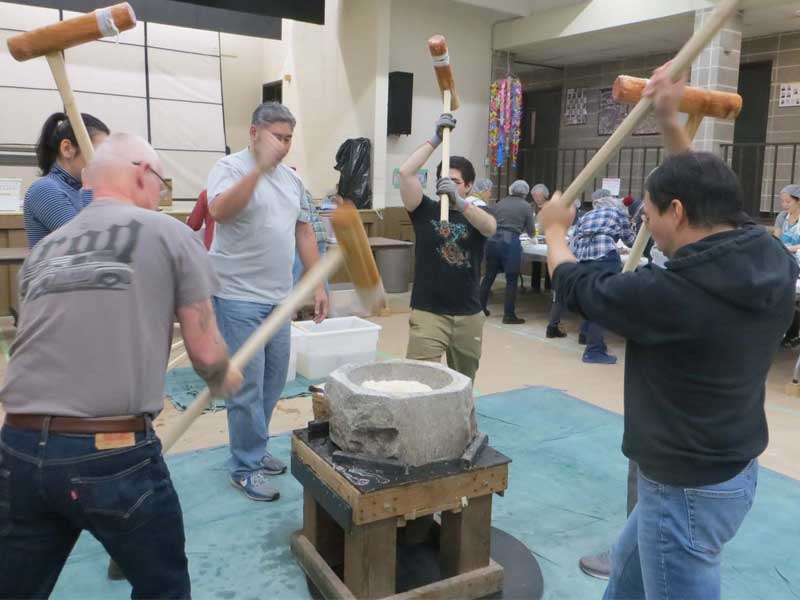
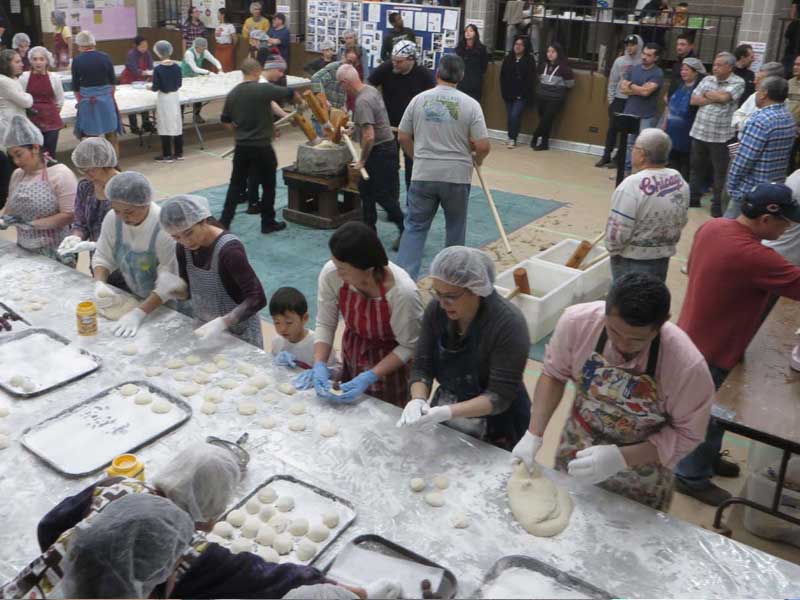
Luckily, it never rained because our family’s mochi-tsuki always took place outdoors with steaming wood boxes over firewood. Only women made the mochi cakes on a temporary table of wooden planks in the exact way we do it today, and the men folks did the pounding in a stone usu.

Even the mochi gome was local and grown by Japanese farmers. These farmers also grew regular rice but mochi gome sold at a premium.

As kids, we really liked mochi as it had a distinct flavor unlike regular rice and a very different texture. Plus, it was made only once a year. (In later years, with the gatherings ended, mochi became commercialized and for sale in boxes holding cakes of different colors in a neat rectangular array.)

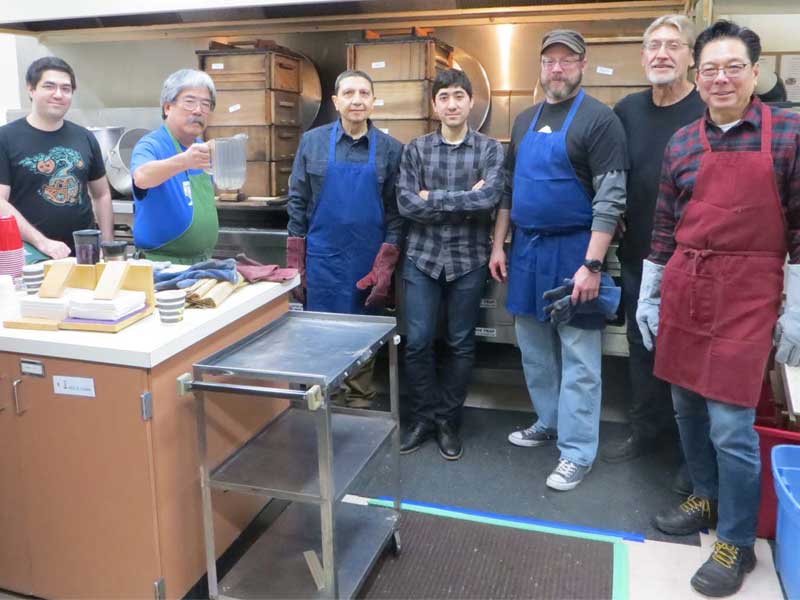
Today, mochi-tsuki is a very rare event in households. But here at the Midwest Buddhist Temple, it continues with vigor and in a volume that would serve a large family (our membership) and any passerby who may have dropped in. It’s a mix of old and new where old still employs steaming boxes, handmade cakes , mallet pounding—and new is represented by a clever machine with a propeller that magically forms a large mochi ball. But some say that it takes second to the pounding method because it contains no wood splinters.

Unfortunately, there will be no splinters and no festival this year due to the COVID-19 pandemic. If it weren’t for COVID, we would have been gathering in the temple’s Social Hall on Dec. 9.

Instead, we thought we’d share some memories of our 2019 Mochi-Tsuki with some photos taken at last year’s festival.

Take my word, we’ll be back with a real Mochi-Tsuki in our Social Hall as soon as we are able. In the months before December 2021, check our digital monthly Bulletin or mbtchicago.org, for the exact date.

Would you like to make a donation for Mochi-Tsuki? Just go to our Donate Now Page. Thank you.

date posted:

December 3rd, 2020|

Why walk during meditation?

Q-60pxDuring Zen Shin Meditation, why do we walk? What is it supposed to symbolize?

A-60pxThere are many kinds of meditation. Sitting meditation, walking meditation and chanting meditation are the most common forms of Zen Meditation. Zen Shin meditation takes these and other forms of meditation as part of the mix of discipline.

Why do we walk? A good question, but I assume it is like breathing meditation—to become aware of the simple things we usually take for granted. Breathing, walking, talking (chanting) and all the usual human activities are usually taken for granted and remind us of being human.

Please consider eating meditation. That is, to eat each meal with full awareness of each bite and with the appreciation and gratitude for all that goes to make up that meal. Consider and be grateful for all the sacrifices that have gone into each bite.

Gassho (with palms together), Rev. Ron
October 28th, 2020|

Differences between Shin, Theravada, Mahayana

Q-60pxHow does Shin Buddhism differentiate itself from Theravada and Mahayana Buddhism? Are there different rules, readings or interpretations?

A-60pxThis would take a long time to answer because it is so complex. But in short, Theravada (school of the elders) tries to follow the footsteps of the historical Buddha with an emphasis on Wisdom. Mahayana Buddhism tries to take the essence of the Teaching (and not the exact letter of the Teaching) and there is an emphasis on Compassion and the Bodhisattva idea. Shin Buddhism comes from the Pure Land School within Mahayana Buddhism. Shin Buddhism is a religion of “thank you” for what I have already received (Wisdom and Compassion) and I only have to become aware of it; while most religions are religions of “please” (as in asking for guidance, asking for grace, or asking for something).

Gassho (with palms together), Rev. Ron

October 11th, 2020|

What kind of temple are we?

The Midwest Buddhist Temple is a temple of the Jodo Shinshu school of Buddhism, with roots in the Pure Land Buddhist tradition. Jodo Shinshu, also referred to as Shin Buddhism, was founded in Japan by Shinran Shonin (1173-1262). It was Shinran Shonin who made Buddhist teachings accessible to people of all walks of life—in contrast to the traditional, primarily monastic practice of Buddhism.

September 23rd, 2020|

Practicing Buddhism every day

Q-60pxHow would one go about practicing Buddhism in their everyday life?

A-60pxFor a Shin Buddhist, everyday life is our practice. It is profoundly counter-intuitive, but fully being a limited human is exactly why we can discover Awakening.

There are not the usual difficult meditations, there are not esoteric rituals to perform. Because we are so ordinary and so limited, we let go of our Ego-Self to be embraced with the Wisdom and Compassion that is Amida Buddha (the symbol of Amida Buddha is the Wisdom and Compassion that is already there in the universe).

Gassho (with palms together), Rev. Ron

September 13th, 2020|

Breathe in, breathe out. Let it all go.

Q-60pxDuring meditation, when your mind begins to wander, how do you get your mind back to the original “focus”?

A-60pxDuring Zen Shin meditation, you count your breathing at a natural pace. So when you lose your focus, become aware of letting it go when you breathe out. One of the sayings that the leader often says is: “Breathe in, breathe out. When thoughts come up, let them come, and then let them go. Don’t engage with them. Let them come, and then let them go with your exhaling breath.”

Gassho (with palms together), Rev. Ron

August 13th, 2020|

Shinran’s teachings: And justice for all

This column originally appeared in the November 2017 Bulletin. We thought its relevance today makes it worth re-sharing.

Q-60pxIf Shinran were alive today and happened to be on the playing field (or basketball court or baseball diamond, you get the picture) as the National Anthem played, do you think he would take a knee?

A-60pxShinran would probably take a knee; he was a radical in his own way. He was definitely not a political person, but he would be annoyed by the U.S. president trying to make political points at the expense of a racial minority.

Not standing for the National Anthem is not about disrespecting the flag and not about showing disrespect to the principles of democracy. Rather, it is about remembering that justice has not always been equally practiced.

He was definitely a person of the ordinary people and would have empathy with Black Lives Matter.

Gassho (with palms together), Rev. Ron

June 24th, 2020|

What is the purpose of Buddhism?

Q-60pxWhat is the purpose that Buddhism is meant to fulfill? I’ve learned about escaping samsara and becoming enlightened but is there another purpose or reason?

A-60pxBuddhism has a broad spectrum of understanding. The “purpose of Buddhism” is to fulfill our full potential and awaken our Buddha-Nature (the potential to become a Buddha).

But, the “purpose of Buddhism” is also to discover Enlightenment and achieve Nirvana. But Nirvana is described as “to extinguish” all desires and selfishness.

And this is to escape Samsara, the 6 Realms of Existence, which are used to describe this world of human limitations. There are so many other ways of explaining Buddhism—maybe, our actions.

Thus, our course of action, when “being tempted,” is to take responsibility for our actions.

Gassho (with palms together), Rev. Ron

May 18th, 2020|

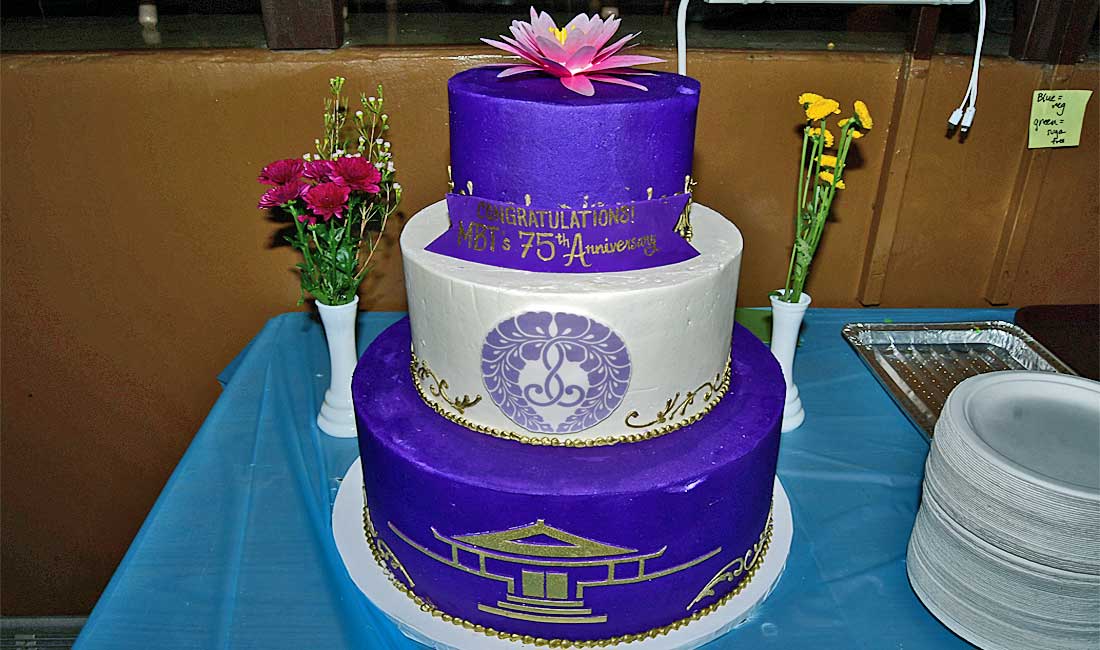
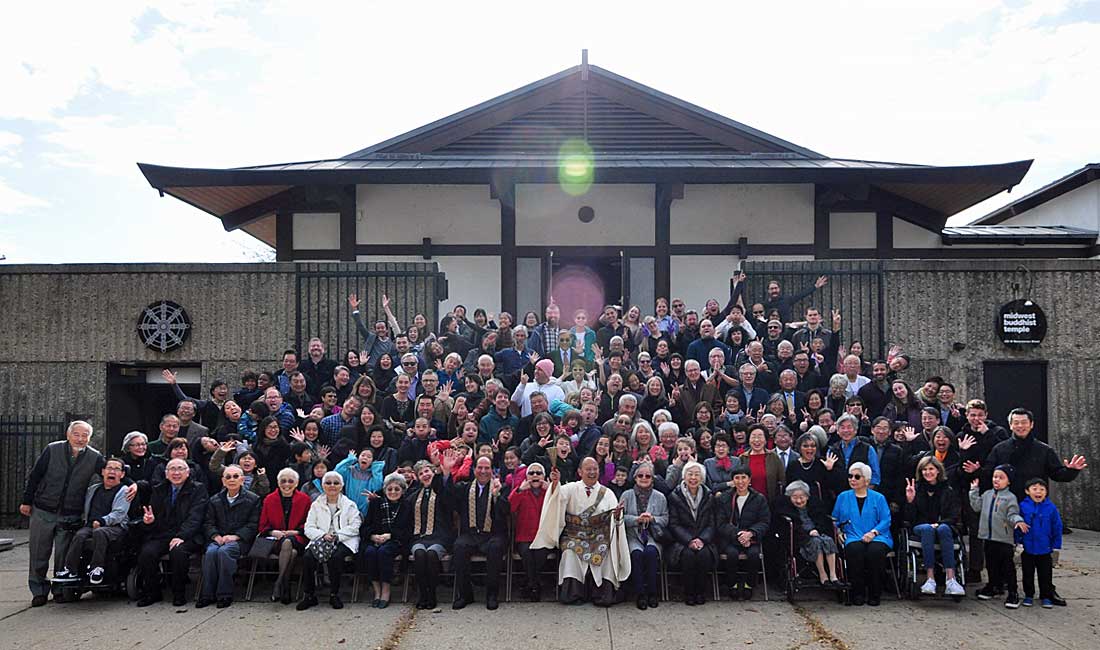
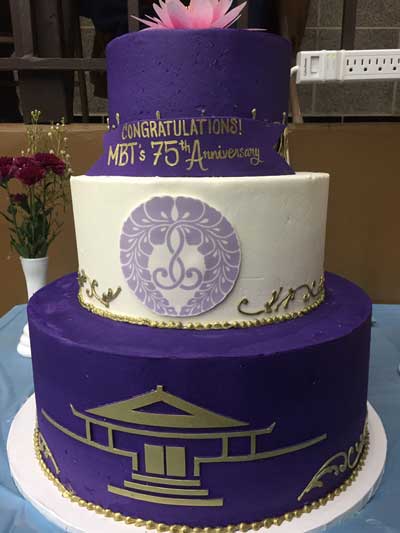
2019 – MBT’s 75th Anniversary (a year long celebration!)

July 10, 1944. South Parkway Community Hall. Southside Chicago. Rev. Gyodo Kono holds the very first service of a small congregation of Jodo Shinshu Japanese American ‘resettlers’. Seventy-five years ago such were the humble beginnings of Midwest Buddhist Temple.

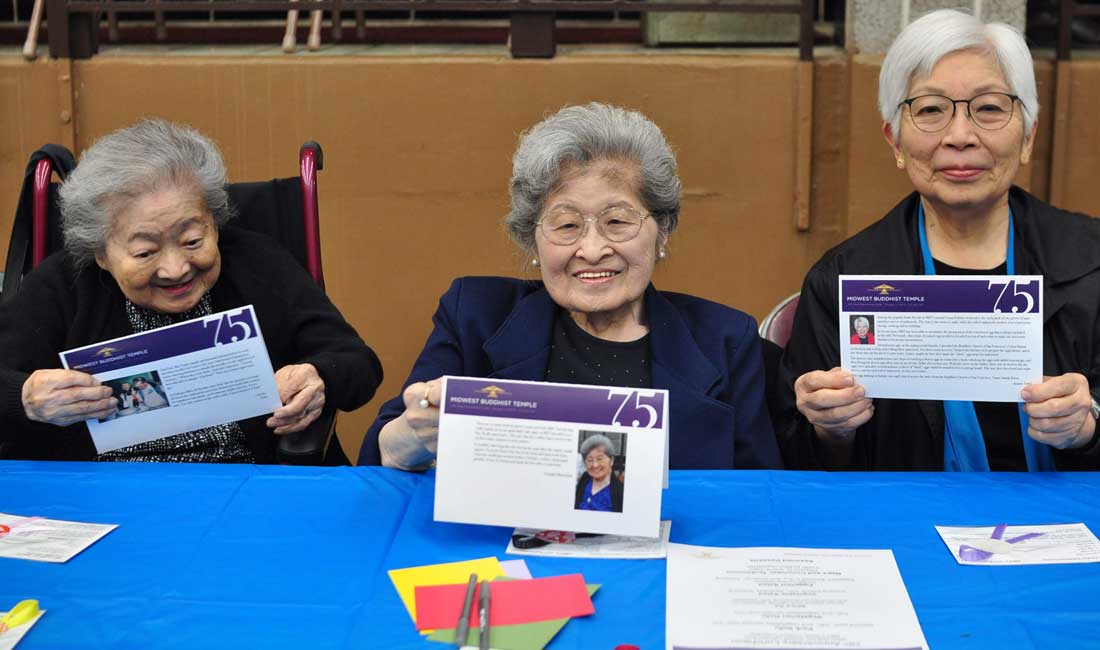
To commemorate our Sangha’s 75th milestone, we held multiple events throughout 2019 to; recognize the challenges facing our founding members, to relive memories of the generation who “came of age” at MBT, and to celebrate today’s dynamic Sangha.

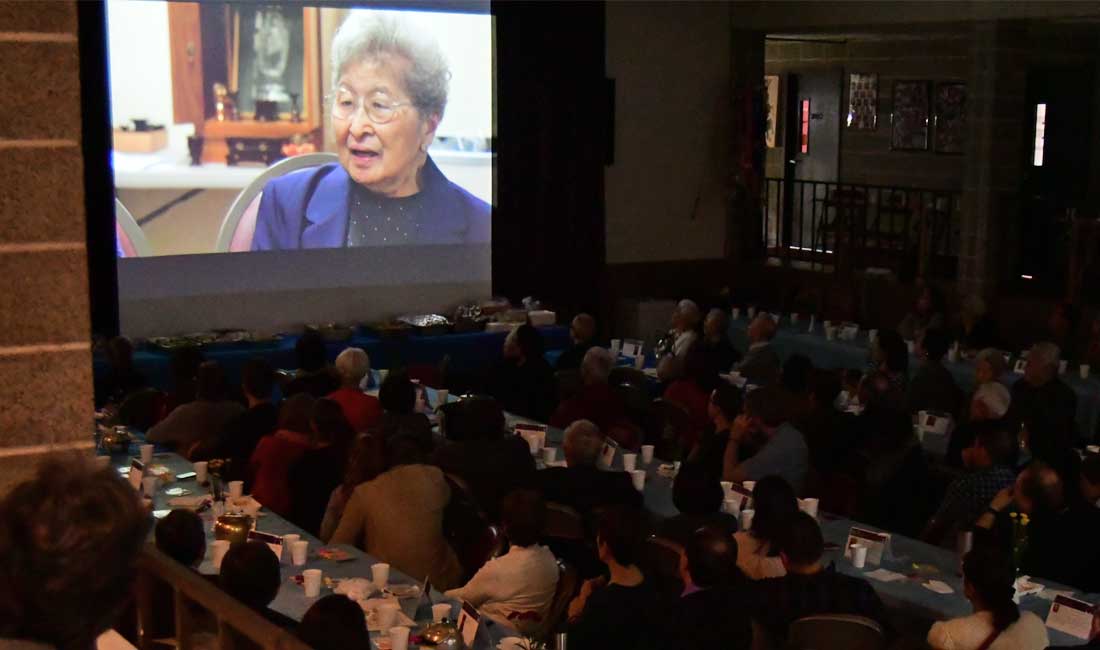
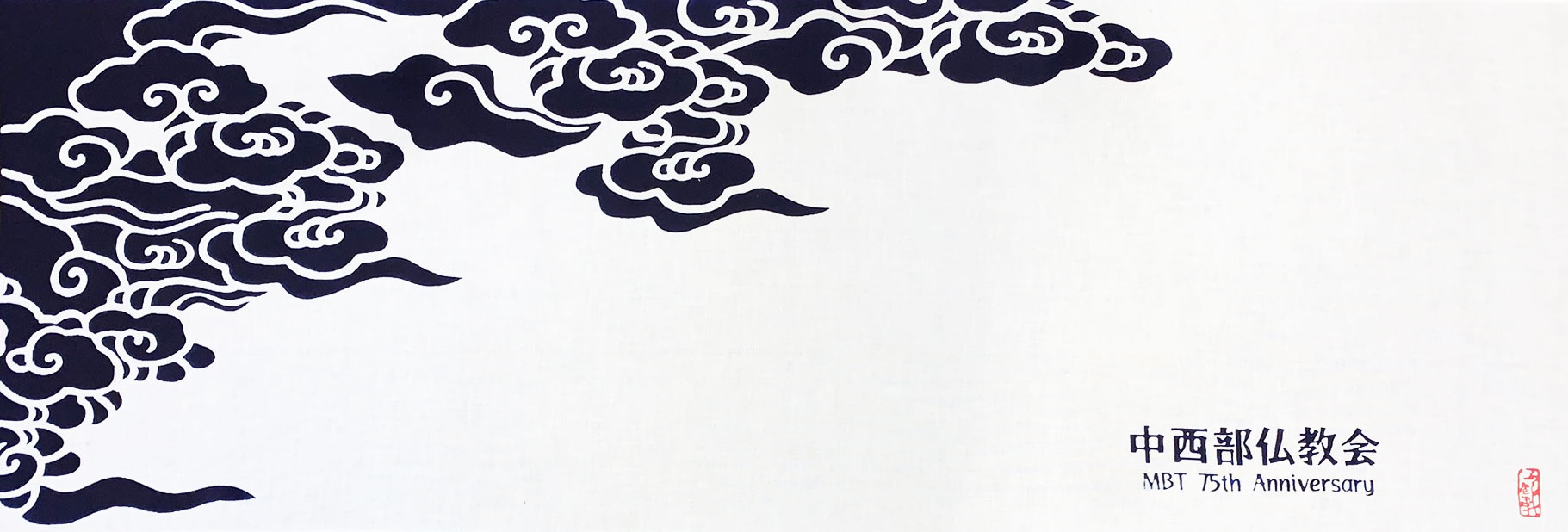
We’ve assembled pictures, articles, memories and even recipes that were all part of our year-long celebration. Among the many things you can view are two very special surprises from our 75th Anniversary luncheon. First we enjoyed a beautiful video, created by Jason Matsumoto, that chronicled our anniversary year and even included rare footage of Rev. Kono as he spoke in our newly constructed chapel nearly 50 years ago. Then each family was presented with a tenugui (decorative Japanese towel) specially designed by Waza artisan, Masahiro Kawakami, to commemorate MBT’s 75th anniversary. We hope you enjoy this collection of memories.

Hints for exploring this page: You can skip to a section by clicking one of the links above or your can simply scroll down the page. Each of the photograph slideshows will automatically start and you can also position your mouse over any picture to pause the display and reveal the navigation controls. 

More from our website:   History of our temple   Current and past ministers   Support MBT

Messages about our 75th Anniversary

REV RON MIYAMURAResident Minister: As we celebrate our 75th Anniversary we should pause to look back with a sense of gratitude and forward with a sense of hope.
Our temple began with just six members in 1944. Rev. Gyodo Kono, just released from the Rohwer Relocation Center in Arkansas, came to Chicago with the ambition to start a Jodo Shinshu temple. We are grateful to Rev. Kono and the many Nisei who risked much to establish our temple during times of great distrust of any persons of Japanese descent.

Our temple not only survived but flourished in the following decades. Having started as an “ethnic” temple our Sangha has now become more diverse. New people are finding MBT through paths such as ZenShin Meditation services and even our Dharma School is attracting new families. This points to a positive future for MBT.

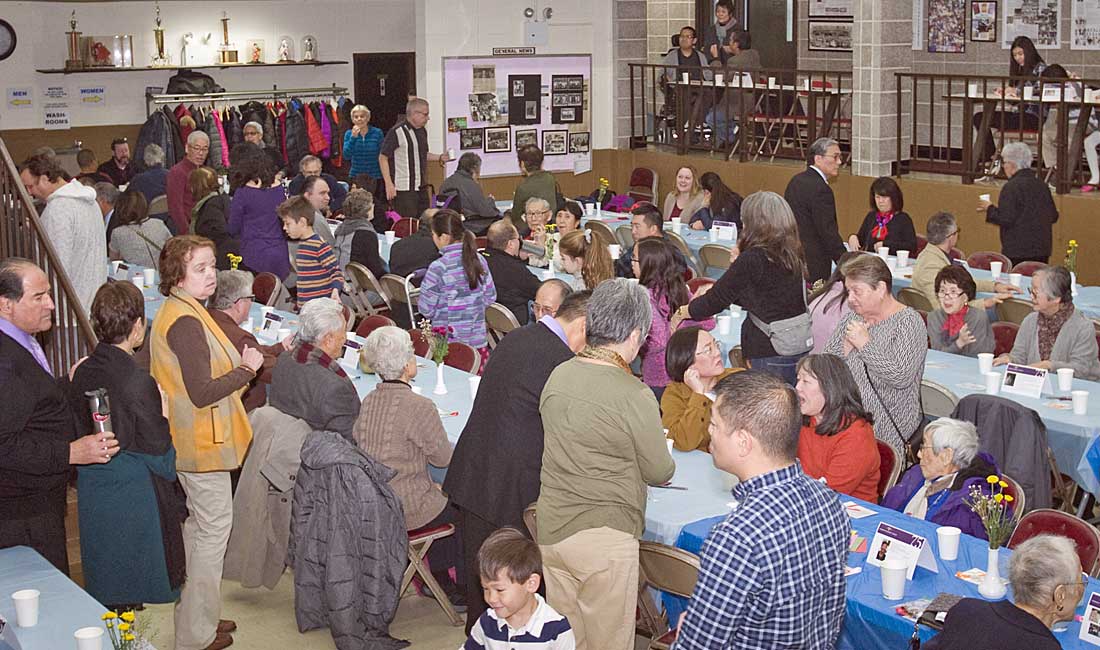
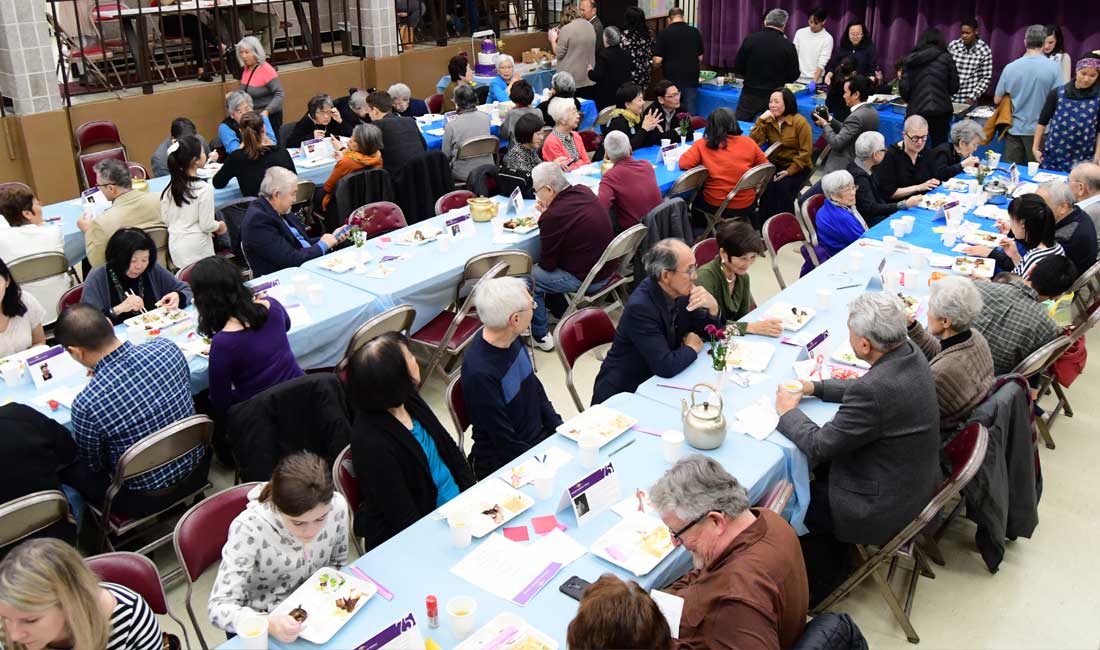
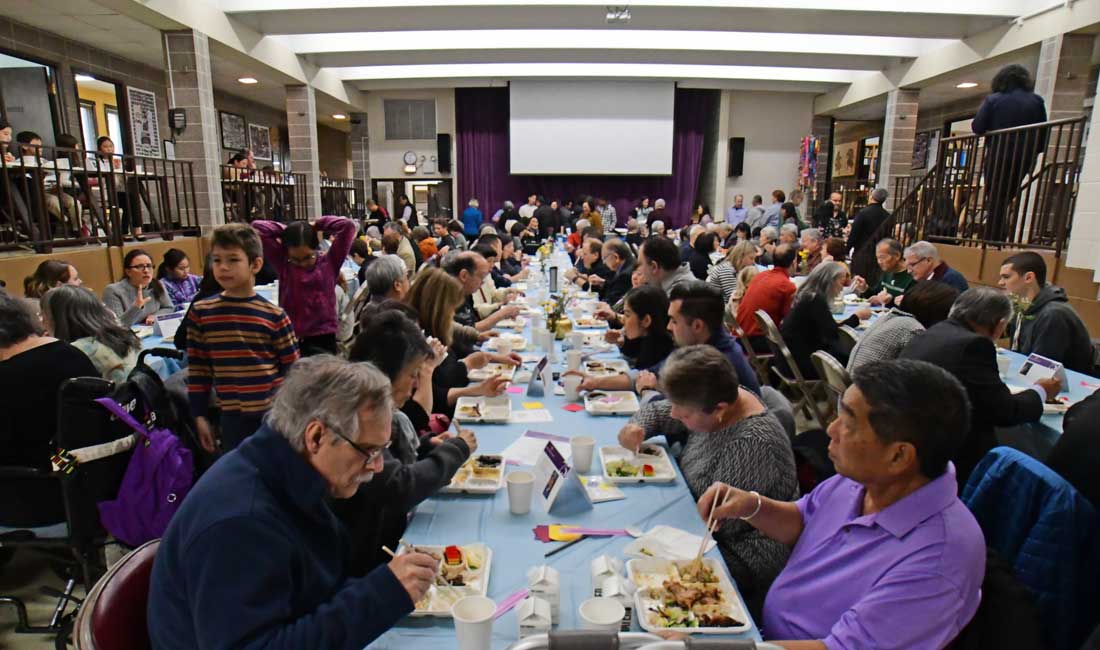
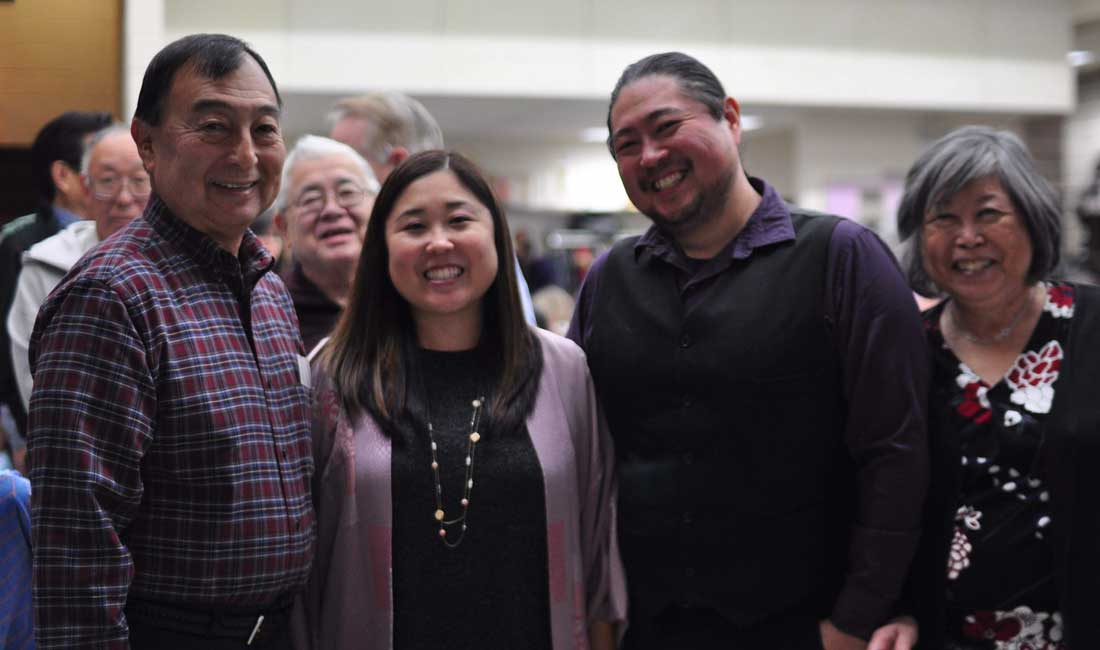
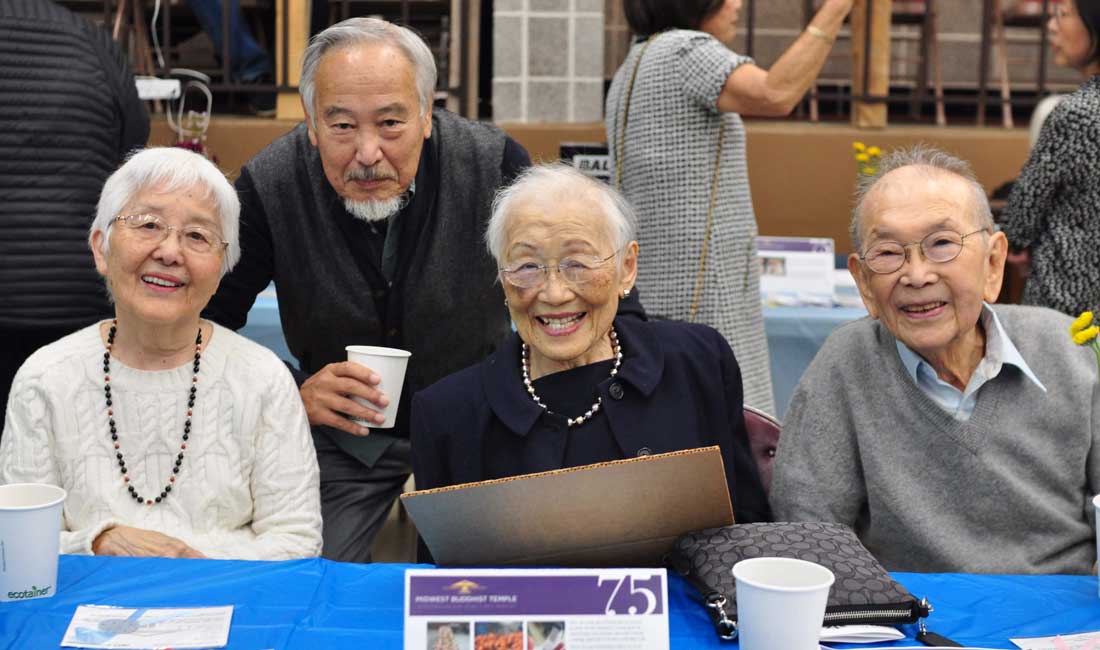
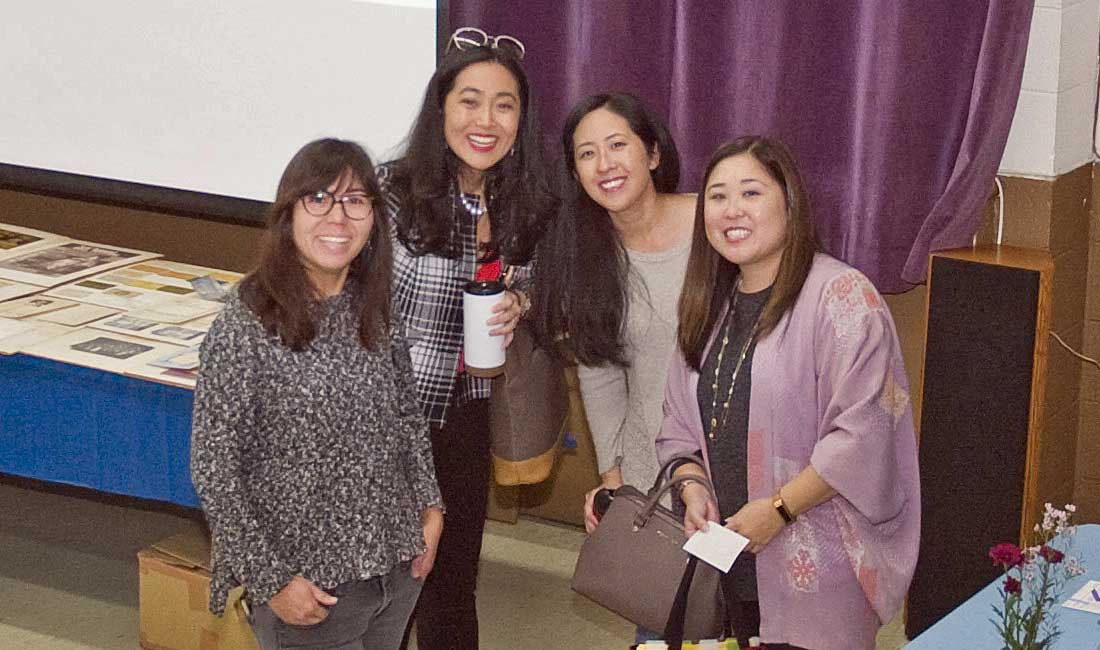
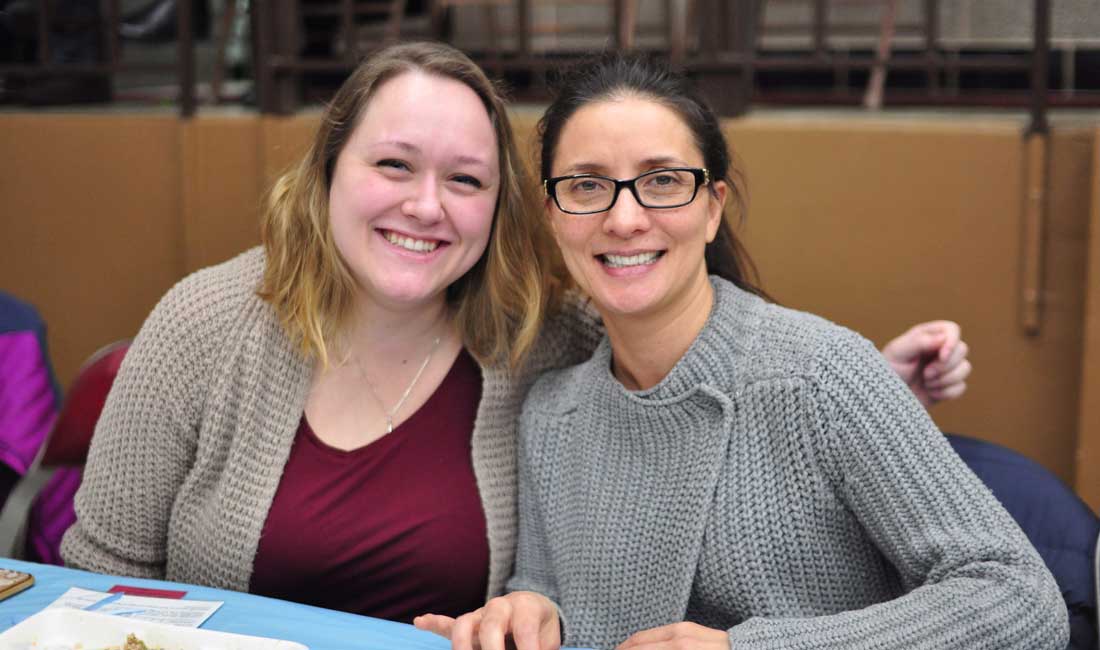
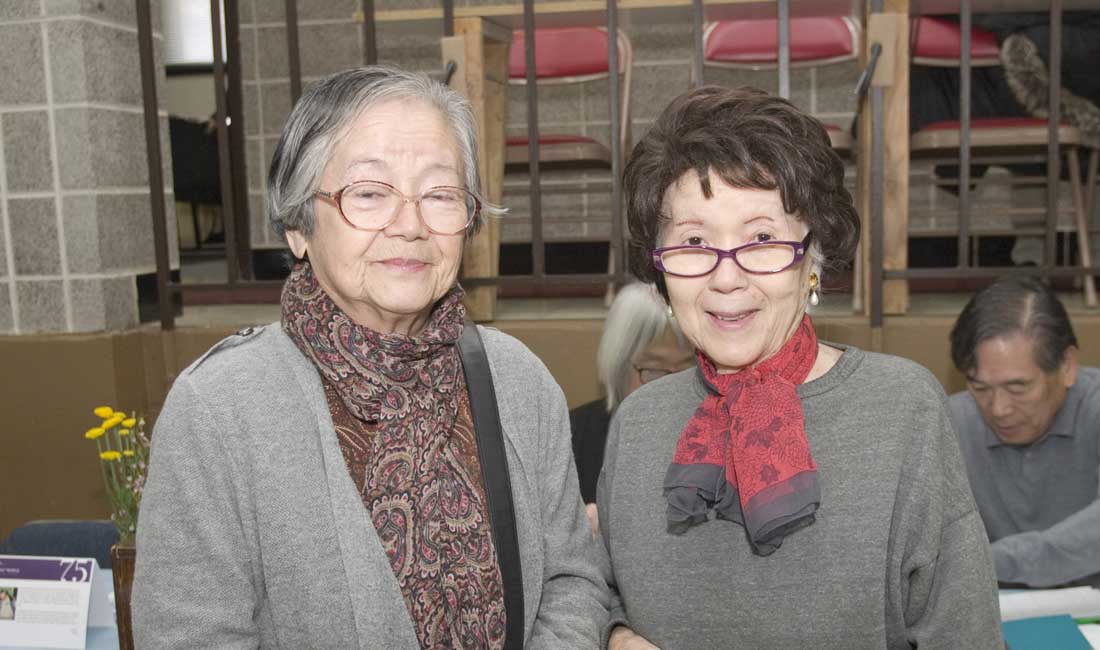
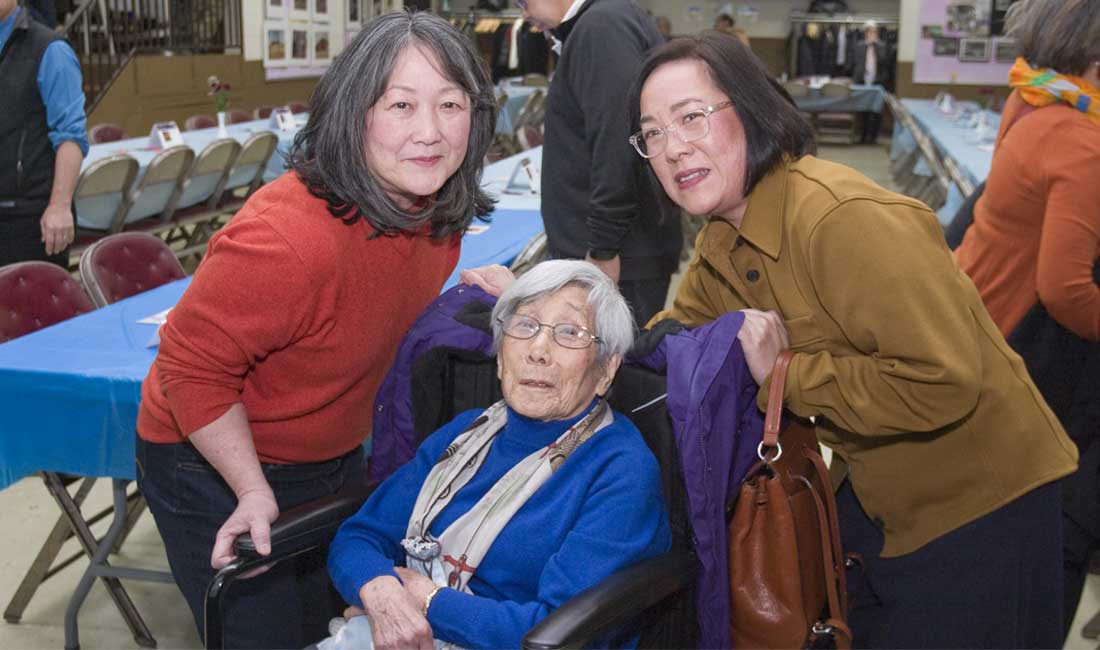
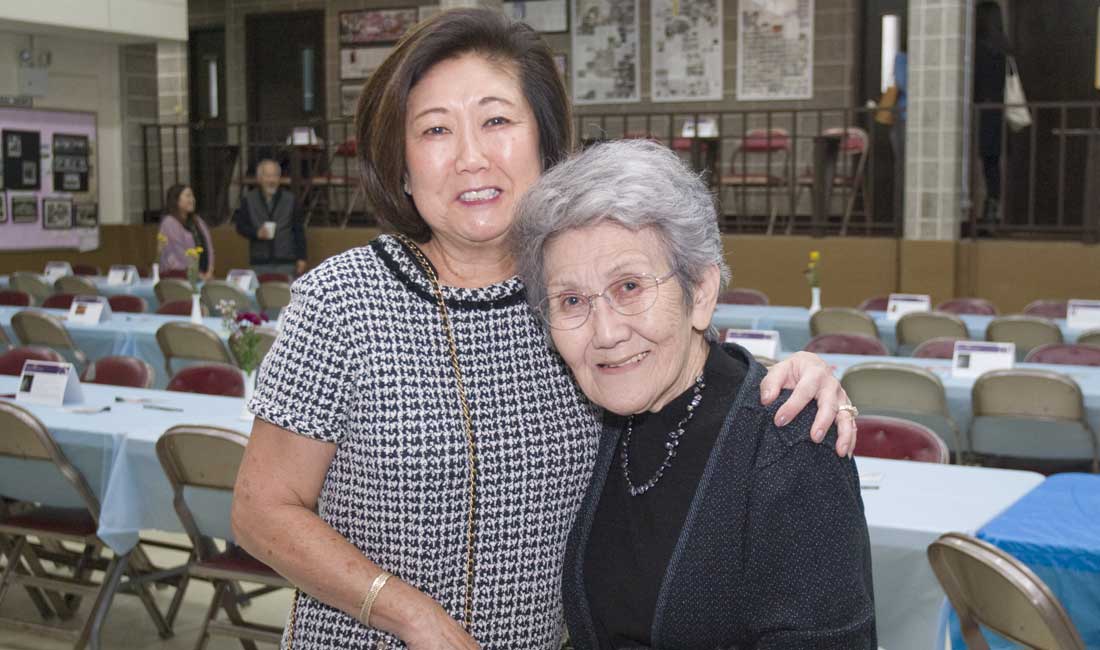
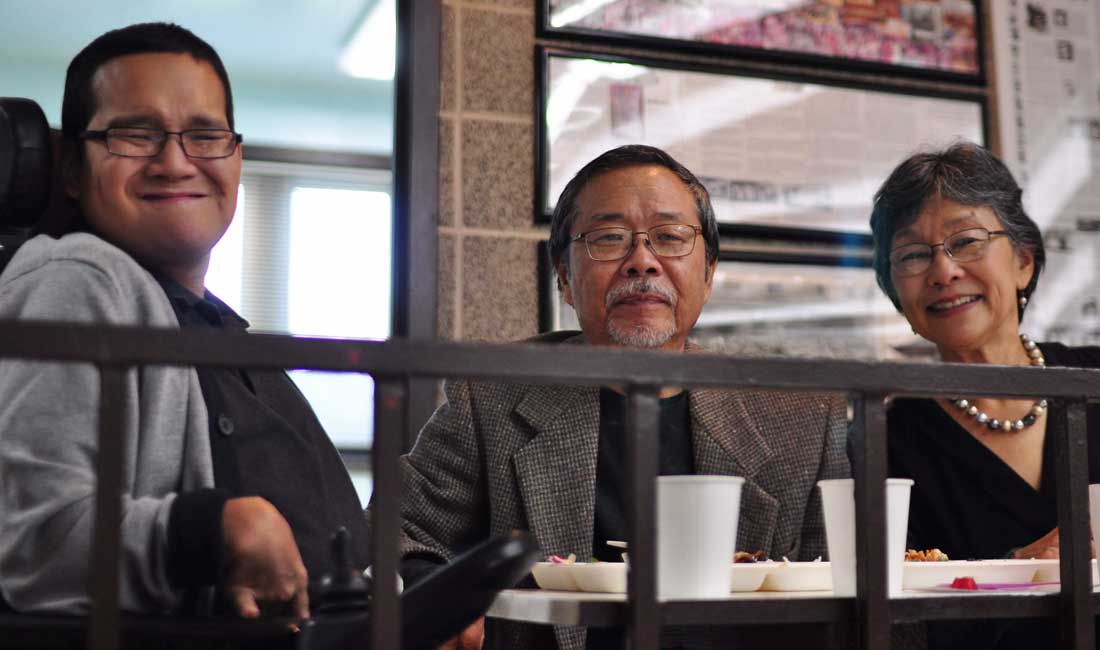
KIKU TAURAMBT President: On Sunday, Nov. 3, Midwest Buddhist Temple capped a year of commemorative events with a luncheon in honor of our 75th anniversary. I was happy to see that an estimated 175 Sangha members and friends came to celebrate the occasion, and the full house reflected the many faces of MBT today.
Nisei attendees (part of MBT’s founding generation) were seated as guests of honor at the front tables, and we were fortunate to see those who could attend, while missing those who were unable to do so. Legacy generations (third-generation Sansei and fourth-generation Yonsei) were well-represented, as well as our members and friends from Zen Shin Meditation. Dharma School families were there in full force, adding their usual energy to an already energized atmosphere.

JASON MATSUMOTO75th Anniversary Committee Chair: MBT, throughout its 75 years, is fortunate to have been under the guidance of  forward-thinking leadership. MBT values openness and inclusivity, inviting people who are 1 mile away or 10,000 miles away to, as Rev. Ron likes to say, “come as you are.”
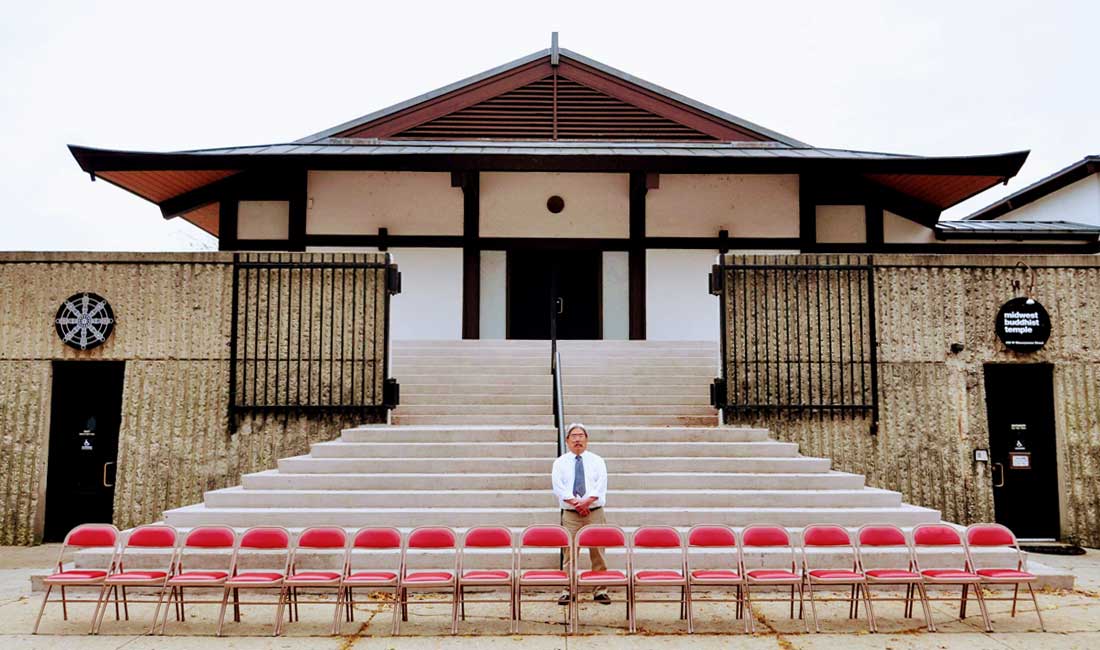
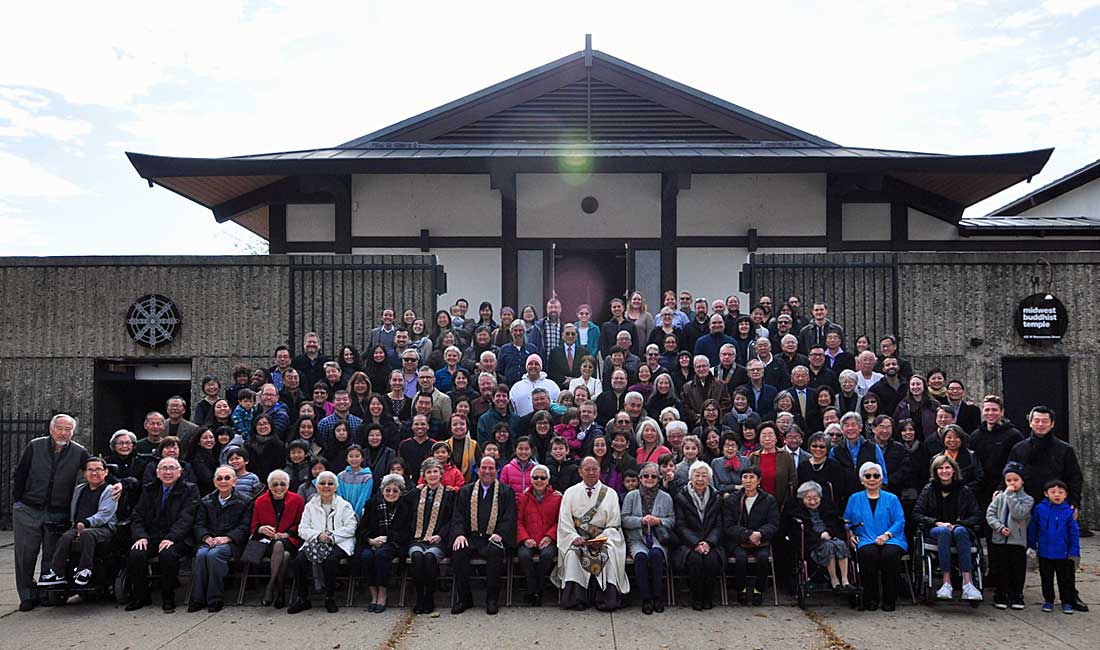
Traditionally, anniversaries at the temple have been celebrated in a single, blowout event. For this year’s 75th, we tried to do things a little differently. Instead of one huge gala, we held a series of events over the course of the year designed to honor, reminisce, and celebrate.

For me this has been a wonderful year of learning (and sharing) more of our history and celebrating our Sangha.

75th Anniversary Luncheon

November 3, 2019

Photography: George Nagata, Jason Matsumoto,
Alvin Hayashi, Alexa Tang, Joy Zavala

Historical Footage of Rev. Kono courtesy of JASC Issei Gerontology Project (1975)
Music: “A Song For You” and “Summer of ’42” by Kishi Bashi (courtesy of Kaoru Ishibashi)
Video Editing: Katherine Nagasawa, Jason Matsumoto

HIGHLIGHTS FROM THE LUNCHEON

click any title to expand the section

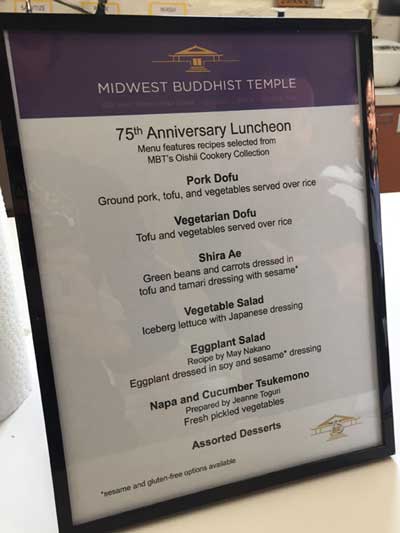
The Luncheon Menu

On Sunday, Nov. 3, we held a special luncheon to celebrate MBT’s 75th anniversary. The event has been on our calendars since about February, when the temple posted a Save the Date on the bulletin board, so it was really exciting to see it come together.

When we thought about this special anniversary, we knew we wanted to do more than just serve lunch to the Sangha. We wanted to really celebrate the temple’s history and highlight all the special relationships that we’ve built as a community over the years. We decided to design the luncheon menu with a spirit of storytelling, using personal memories and stories as a way to share our history.

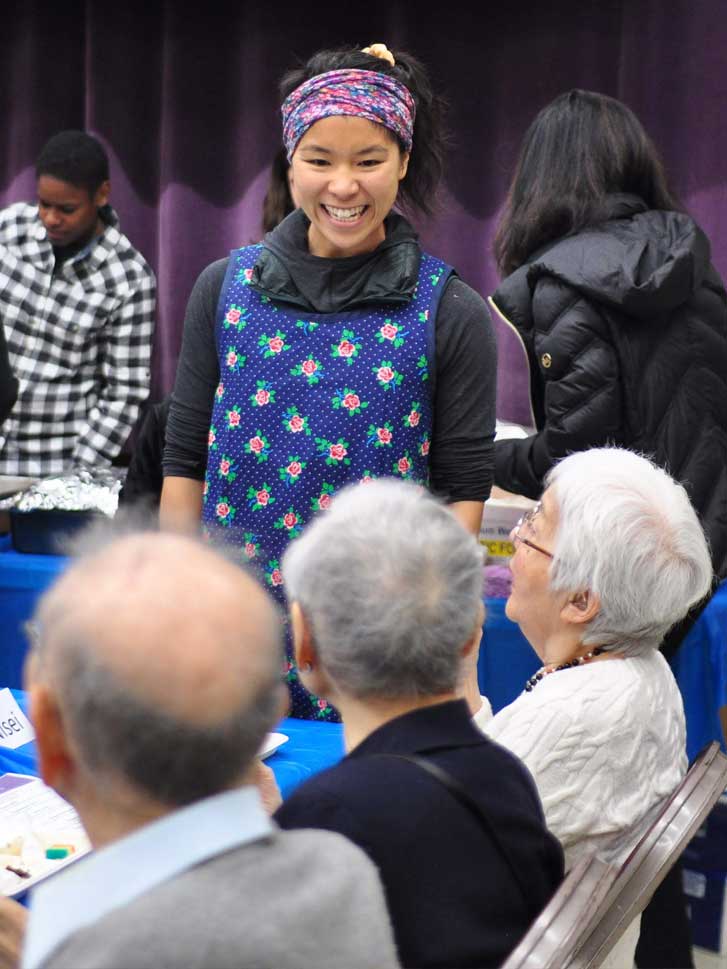
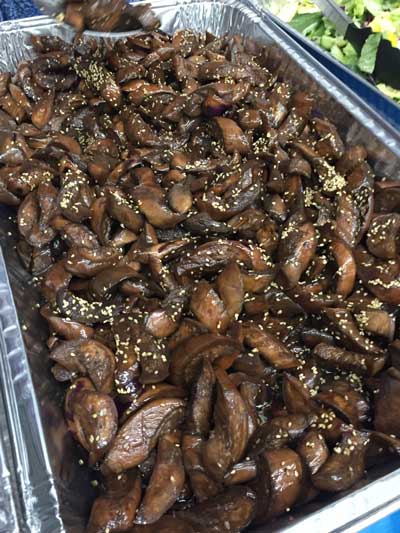
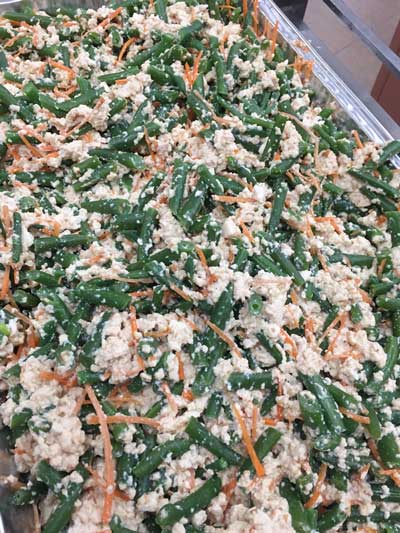
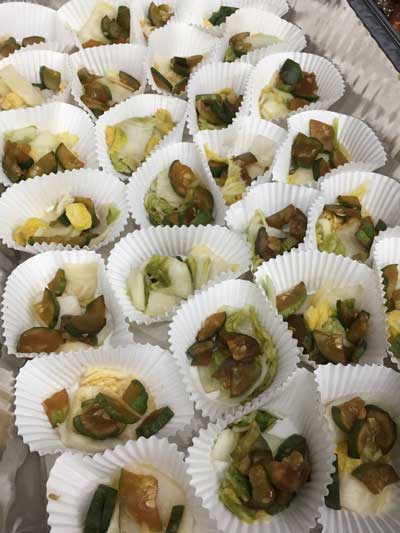
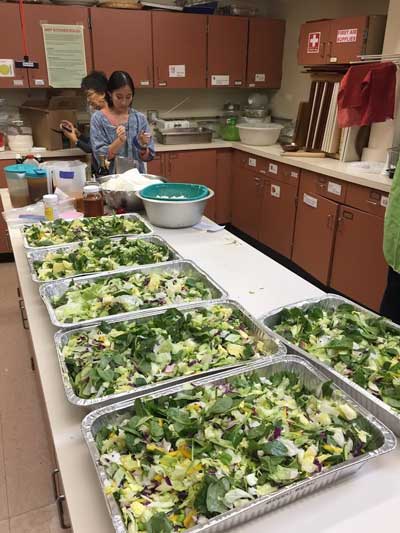
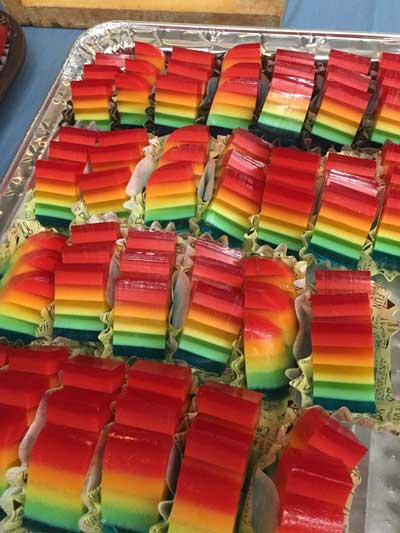
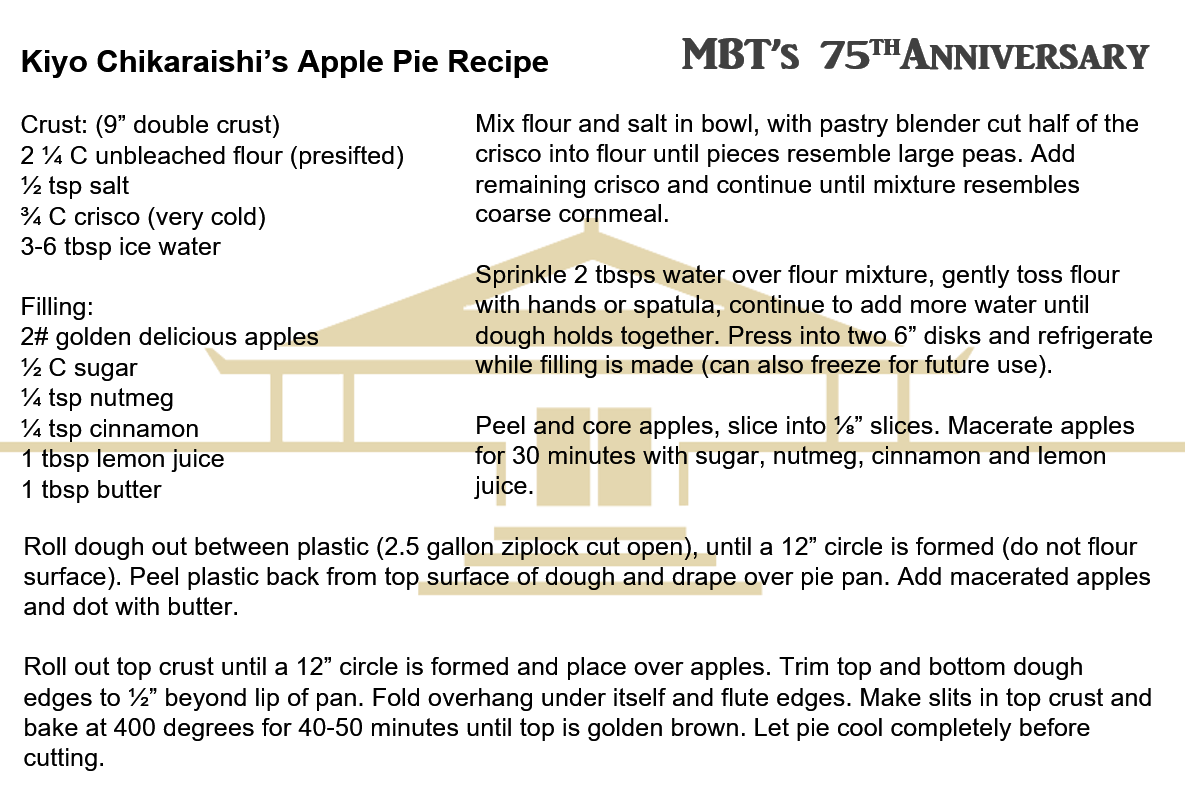
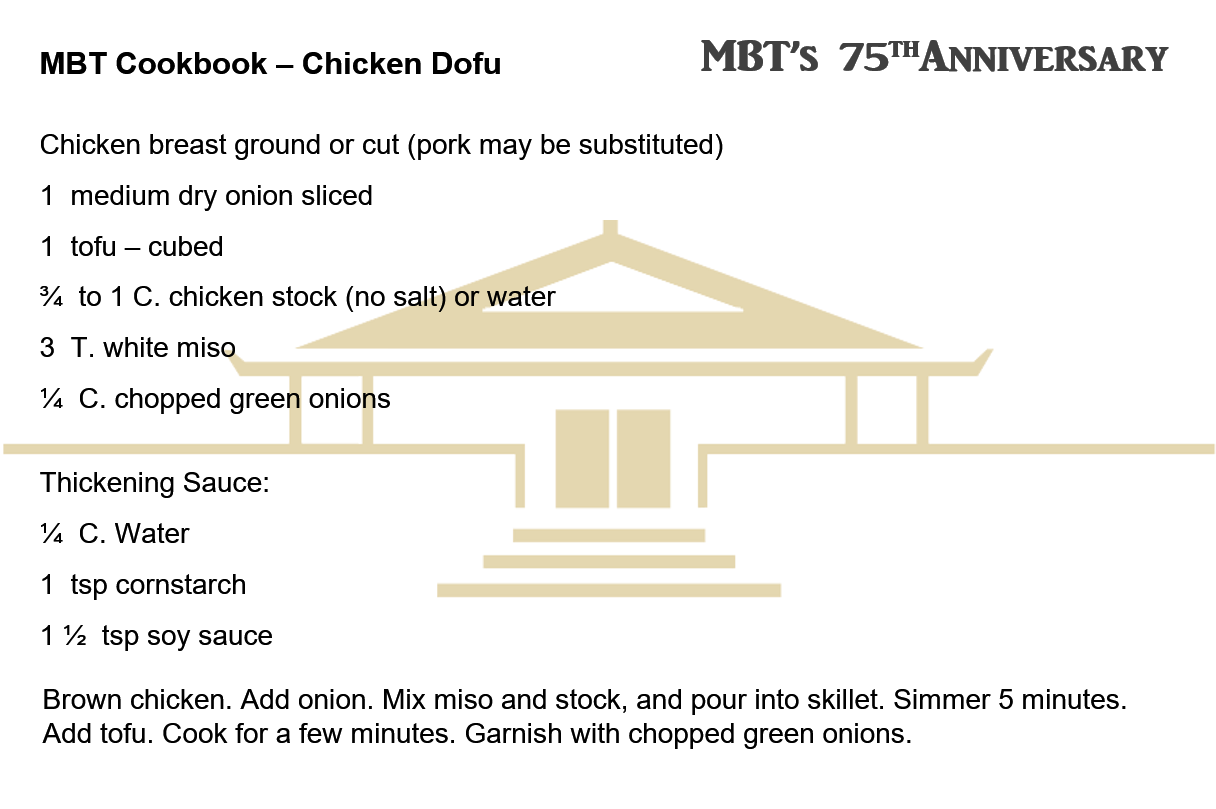
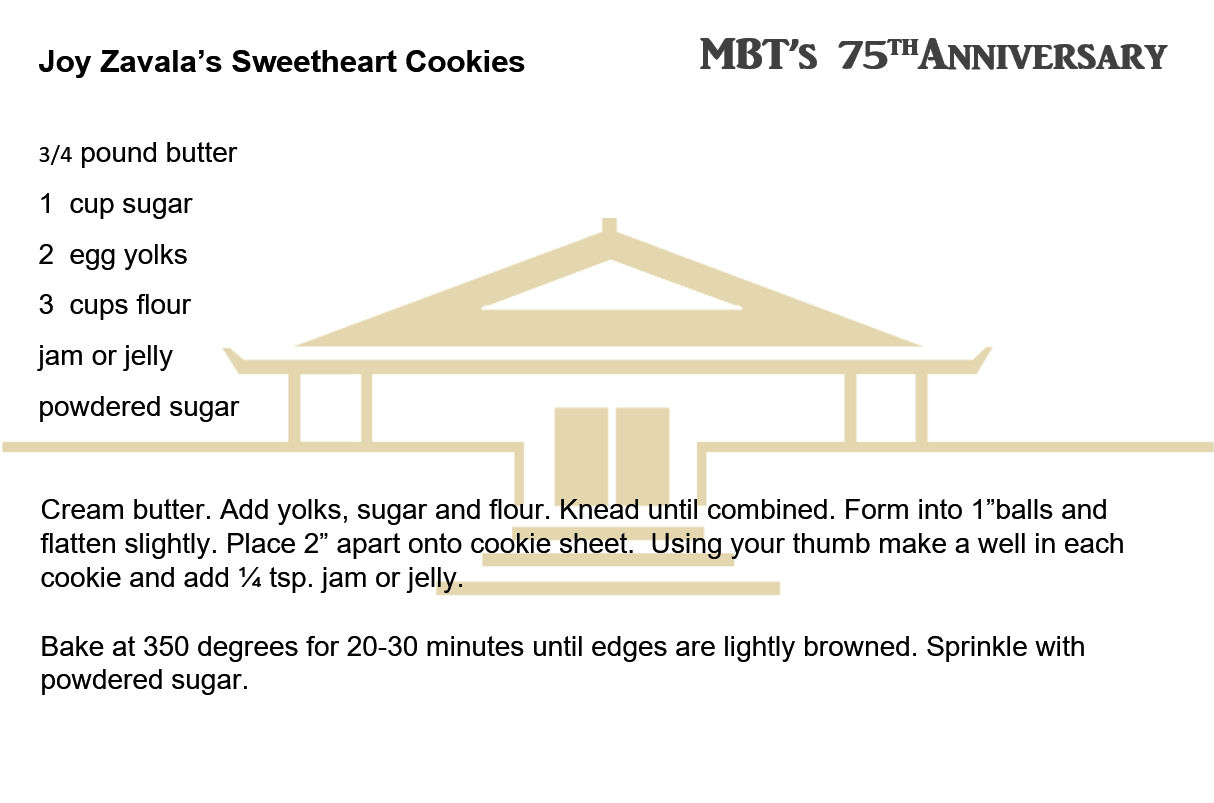
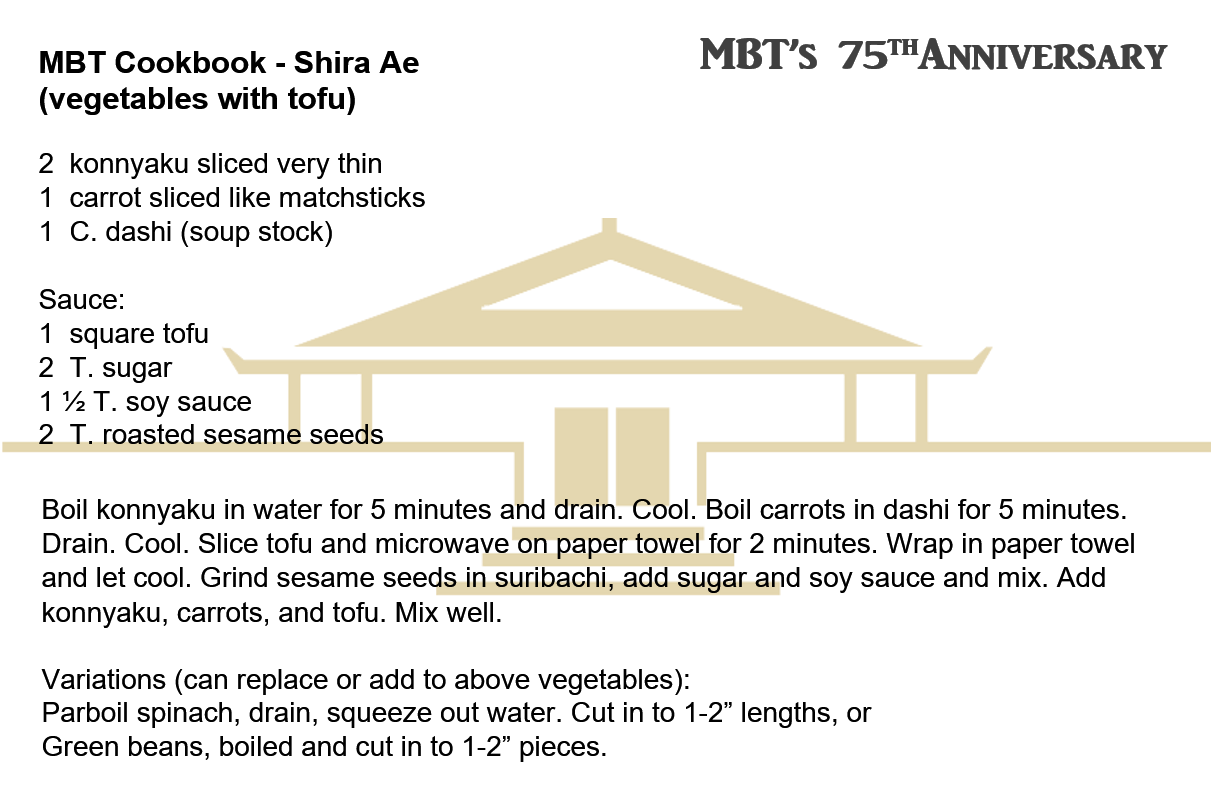
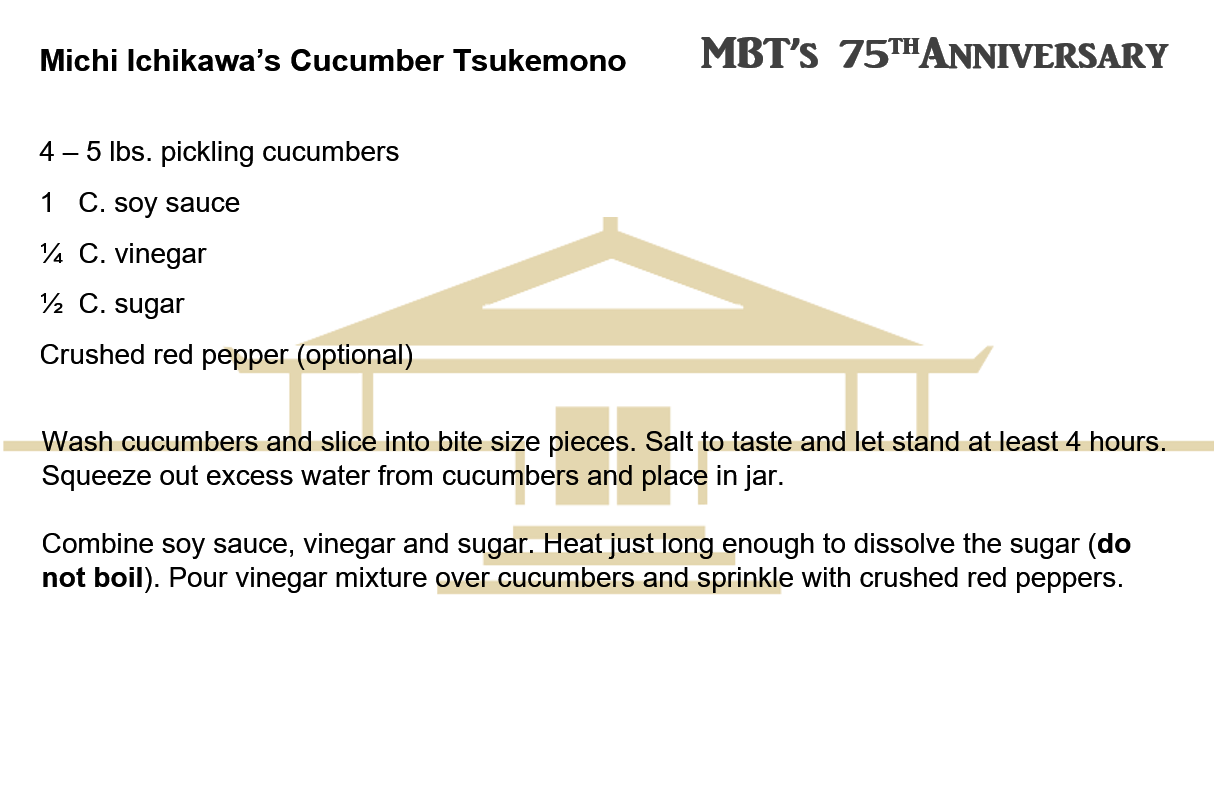
For lunch, we enjoyed a meal prepared by members of the temple’s affiliate groups, including Ho Etsu Taiko, MBT Taiko and the Zen Shin meditation group. The menu included recipes from the MBT “Oishii Cookery” cookbook along with a few favorites from temple members—chicken (sub turkey for the day) dofu, shira ae, nasu, tsukemono and salad. Everyone who attended got copies of these recipes so they could continue making them at home.

A special thank you to all who helped to plan and execute a wonderful event, and a wonderful set of events throughout 2019 to commemorate the temple’s 75th anniversary. We look forward to celebrating many, many more together!

by ALEXA TANG (reprinted from MBT Bulletin Dec 2019 – Jan 2020)

Recipes from MBT’s “Oishii Cookery” Cookbook

(position mouse over recipe card to reveal navigation buttons)

Tenugui Gift – The Story of its design

The tenugui was inspired by Jason Matsumoto’s desire to have a unique, hand-crafted memento to commemorate the Anniversary. He commissioned Fujiya, one of the premiere tenugui shops in Japan, operated by second generation artist Chihiro Kawakami and his son, Masahiro. They are well-known to our members as they have been coming with the Waza craft persons to our Ginza festival for 37 years.

Masahiro Kawakami

Starting in January, Harumi Ichikawa exchanged ideas with Masahiro that included elements from Chicago like the skyline and city flag. Numerous designs evolved over the next 6 months from graphics to Japanese calligraphy before focusing on “The Windy City” using a cloud motif. Just as our Anniversary was designed to honor our past while looking to our future, the tenugui combines traditional elements in the design with modern elements in the type style of the words. The final design was selected in August when Masahiro was in Chicago for Ginza. In September, Harumi was in Japan and worked with Masahiro at the family’s shop in Asakusa to select the final type font.

Tenugui is made from a cotton cloth roll about14 inches wide. The stencils are hand cut, then each tenugui is dyed, and trimmed to about 40 inches from the master role. A unique paper wrapper was designed and printed, then each of the 250 tenugui were folded and placed in a wrapper.

The shipment was scheduled to leave on September 26, just as a typhoon struck Japan, delaying all mail. Miraculously, they arrived just 4 days before the luncheon.

The temple gave a commemorative tenugui to each of our Nisei and pledge members in appreciation for all that you have done for MBT.

by CARL ICHIKAWA

1000 Cranes (MBT Dharma School)

Congratulations to the Midwest Buddhist Temple on its 75 th anniversary. The MBT Dharma School has a long history at this temple and we are very grateful to be a growing and active part of the sangha.

During the school year, the children spend each Sunday learning about theBuddha’s life and teaching through stories, activities and etiquette. We alsocelebrate holidays and traditions including Hanamatsuri, Bodhi Day, Mochitsukiand most recently Halloween.

In September, there is a special day to mark the International Day of Peace. In Dharma School, we commemorate this day by participating in activities to contribute to building a Culture of Peace.

We learned about the story of Sadako Sasaki who was 2 years old on August 6 th, 1945, when she was impacted by the atomic bomb on the Japanese city of Hiroshima during World War II. Sadako was contaminated by radiation poisoning. When she was 12 years old, she learned she had leukemia.

During her treatment, she and other patients received a gift of colored origami paper cranes as a get-well present. This gave Sadako an idea and she believed in a legend and wish that if you fold a thousand cranes, you would get over your sickness.

Sadako dedicated hours each day to folding cranes. According to her brother, Sadako exceeded a thousand cranes, but her wish was not to be. She passed on October 25 th , 1955 at the age of 12 surrounded by her family.

After her passing, Sadako’s story of her determination spread around the world. Her short life inspired the Children’s Peace Monument in Hiroshima where she is memorialized by a statue of her holding a crane to honor the children who died from the atomic bombing. Each year, people from around the world travel to Hiroshima and bring their own origami cranes as a gift to Sadako’s memory and as a symbol of their wish for peace.

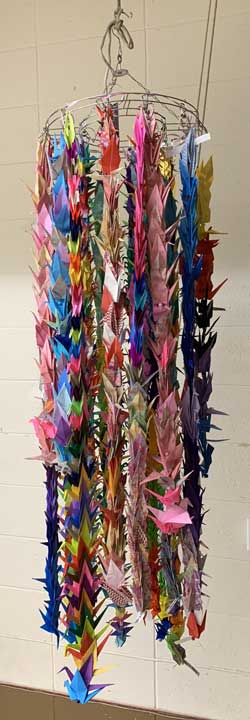
The Dharma School would like to express their wish for peace, happiness and eternal good luck to the temple and world. We are very grateful for being part of the temple and appreciate its rich history and legacy. During the past year, the children, parents, friends and Dharma School teachers folded 1000 cranes. We would like to mark this special 75 th anniversary occasion with the 1000 cranes or senbazuru displayed here. A very special thank you to Eli and Miss Terry for their time to string these cranes for the display today. We hope you enjoy our senbazuru and we hope to keep this visible for all to see.

JENNIFER TOGURI

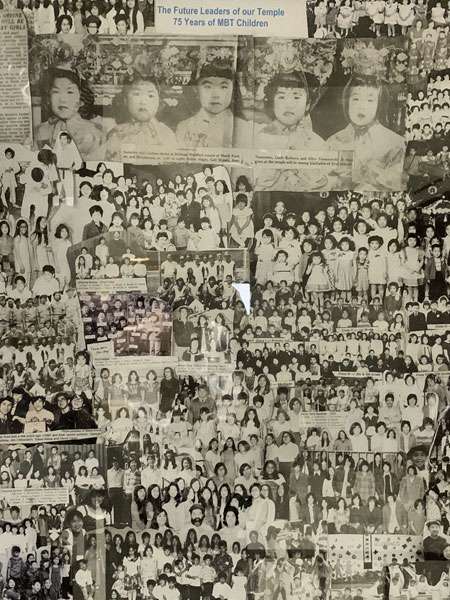
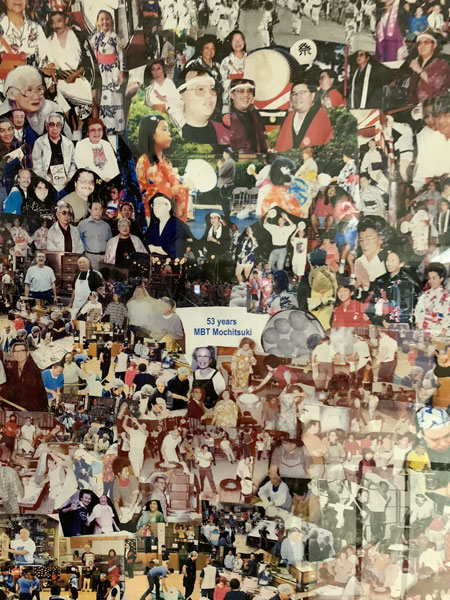
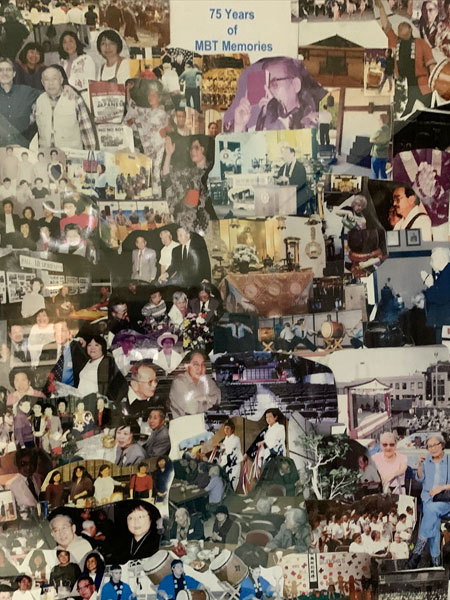
Photo Collages

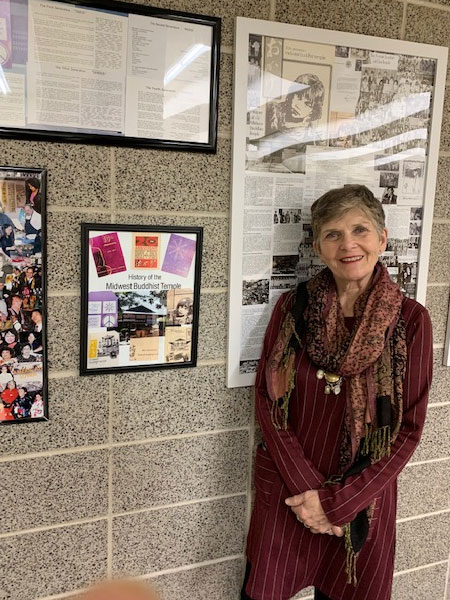
Long time member and Minister’s Assistant, Cynthia Mee created a series of amazing photo collages consisting of thousands of photo-clips  spanning decades of MBT history. Just in time for MBT’s 75th Anniversary celebration Cynthia had her collages mounted on the Temple’s walls. Below, Cynthia provides some insight to her creations.

How did you come to the idea of this project? The collages were created to share our rich history. I thought it would be important for our Sangha members and others to explore MBT through a variety of images to share the dream that Rev Kono had when he came to Chicago after leaving camp. The idea to create the collages was based on my work in our MBT library and viewing vast numbers of photographs. I realized how important it is to share our photographs for many and not just have them in albums. The inspiration for this particular type of collage came from collages my sister, Linda, creates.

How did you approach the project and how long did it take? To answer the question of how long it takes to make a collage is not easy to answer. It is hard to imagine the amount of time each collage took or as a collection. Some collages probably took a minimum of 15 – 20 hours each and others 5-10 hours. Each collage tells a story that has to be composed through selecting, copying, cutting, arranging, and rearranging thousands of photographs.

Final thought? The collages were not created just for the anniversary luncheon. The optimism is that they will be on display for a long time so others will continue to enjoy looking at images of MBT’s incredible history and to learn about our past as we move into the future.

editor’s note: The pictures on this page simply do to do justice to the original collages – we encourage you to visit the Temple to view Cynthia’s work in person.

Memories

(position mouse over image to reveal navigation buttons)

Memories collected at the 75th Anniversary Luncheon

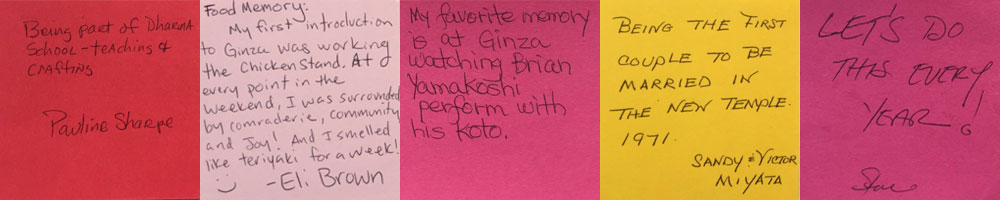
  1. Being part of Dharma School – teaching and crafting. – Pauline Sharpe
  2. My favorite memory is at Ginza watching Brian Yamakoshi perform with his Koto.
  3. I have only been here a year but have already shared in so many memories. From being welcomed in to the MBT Band to performing with MBT Taiko in my first every Ginza Holiday. I am grateful for all the memories and wonderful people I have met. Here’s to many more years and memories. – Jenny
  4. The strength of MBT is its Sangha. It is wonderful how we succeeded in passing the torch from generation to generation and adapting Buddhism to American culture. We shall persevere by working together.
  5. One of my food memories is sneaking cookies before and after service. I used to see how many I could eat without getting caught. – Josh Fidler
  6.  Food Memory: My first introduction to Ginza was working the Chicken stand. At every point in the weekend I was surrounded by camaraderie, community, and joy! And I smelled like teriyaki for a week! – Eli Brown
  7. I remember our Halloween parties that we had when I was in Dharma School. One year we had a spooky room where we touched grapes & spaghetti thinking they were body parts. – H. Nobuhata
  8. I remember how the Issei used to have an unofficial women and men’s side that they gravitated towards during service. I used to love seeing them chatting in their chairs along the walls before service. – H. Nobuhata
  9. At the old temple I pee’d in the social hall during choir practice as a little kid, Yuck! – anonymous
  10. I volunteered to work the Teriyaki grill for Ginza one year. It was 90 that day (and 120 by the grill!). I was very hot and probably not smiling. One of the veteran grillmasters called me to a small cooler behind the grills. From there he produced a bottle of nice whiskey and offered to share. I was a more happy chef afterwards.
  11. Serving Chicken Teriyaki at MBC First Time! I was 15 years old and helped serve the plates to people who bought. Afterwards we got to buy the unsold chicken at discounted rates. – Helen Ideno
  12. I remember when my children came to church for karate lessons and my son said the sensei has dirty feet. – Nancy Endo
  13. I made many new friends and acquaintances at the noodle lunches after Sunday Service. It was a time to sit, talk, get to know others while enjoying the meal.
  14. Being the first couple to be married in the new Temple – 1971. – Sandy & Victor Miyata
  15. I appreciate the opportunity to enjoy the music together with the Sangha.
  16. When we (the Dharma School) smashed and boiled rice to make mochi with seaweed on it. – Isabella Terrone
  17. I remember when me and my friends worked at the Shave Ice stand for Ginza and we had lots of fun. – Dominick
  18. My husband and 10 year old daughter have been coming to the Temple for Sunday meditation. This tradition brought them close, sharing this special time together.
  19. A nice memory that I had was when we worked at the shave ice stand and I got to shave ice for the first time. – Mariko
  20. I love going to the temple for meditation and I look forward to it every Sunday! – Maia
  21. When I ran the shave ice stand. – Kailani
  22. Fireflies, popsicles, drumming, lanterns, children swinging high, remembrances during Obon. – H. Nobuhata
  23. Let’s do this every year! – Steve
  24. MBT Memory – Obon odori is the most memorable for me because I remember my first kimono and obi. I was so excited about the dancing and wearing my kimono for the first time. I was 9 years old. Today my sons participate in all the activities at MBT. It’s a great place for family. – Lisa Macri
  25. When I first started at MBT the Bake Sales were very meaningful. It was a way to talk to people buying and a way to engage in the larger community for whom the proceeds were donated. – Susan Gilkey

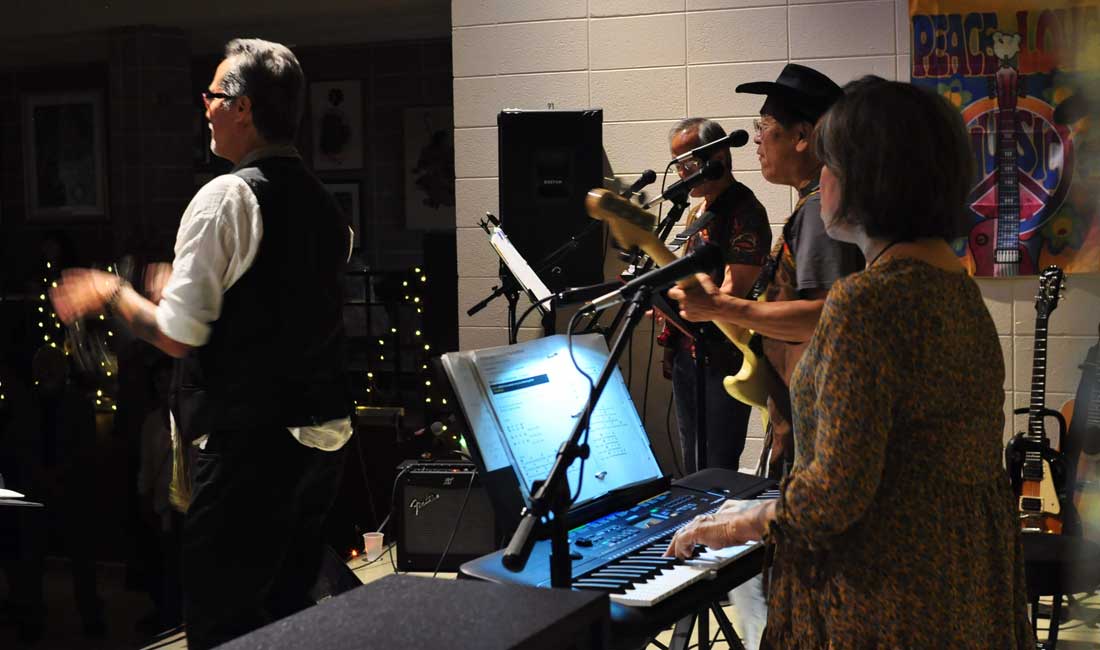
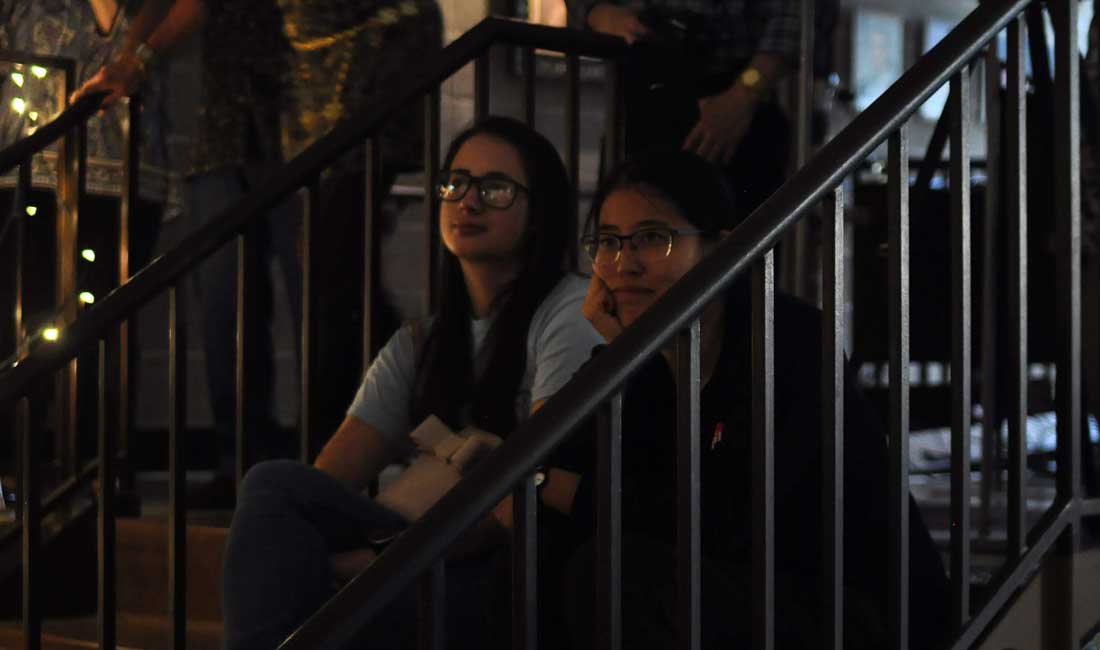
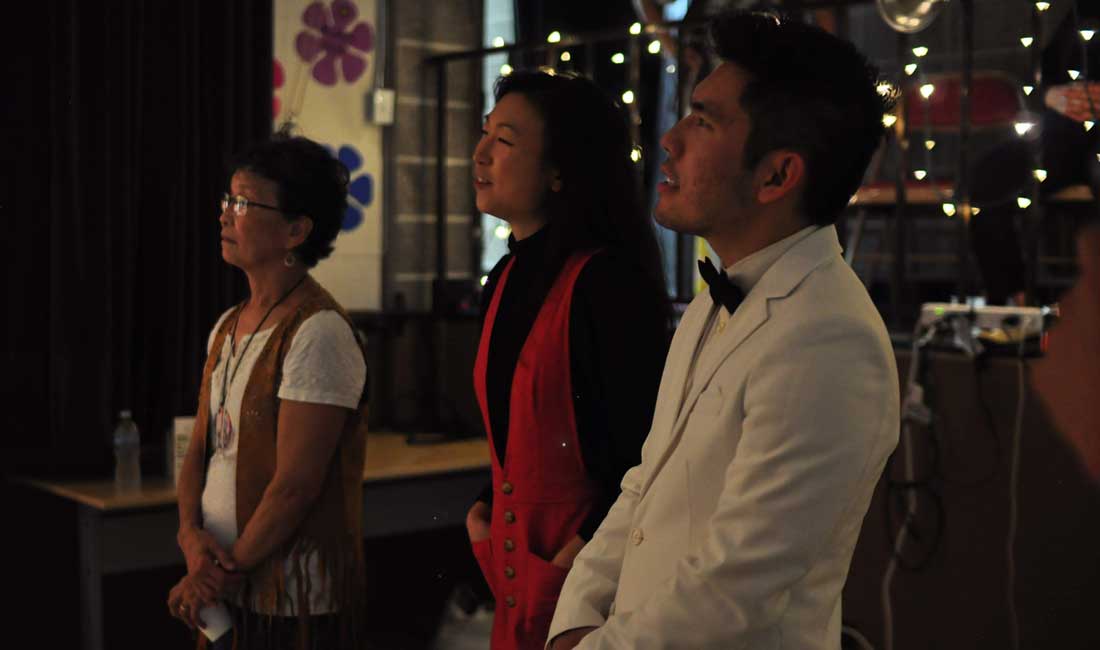
Nikkei Nights; “Talking ‘Bout My Generations

September 21, 2019

Picture this

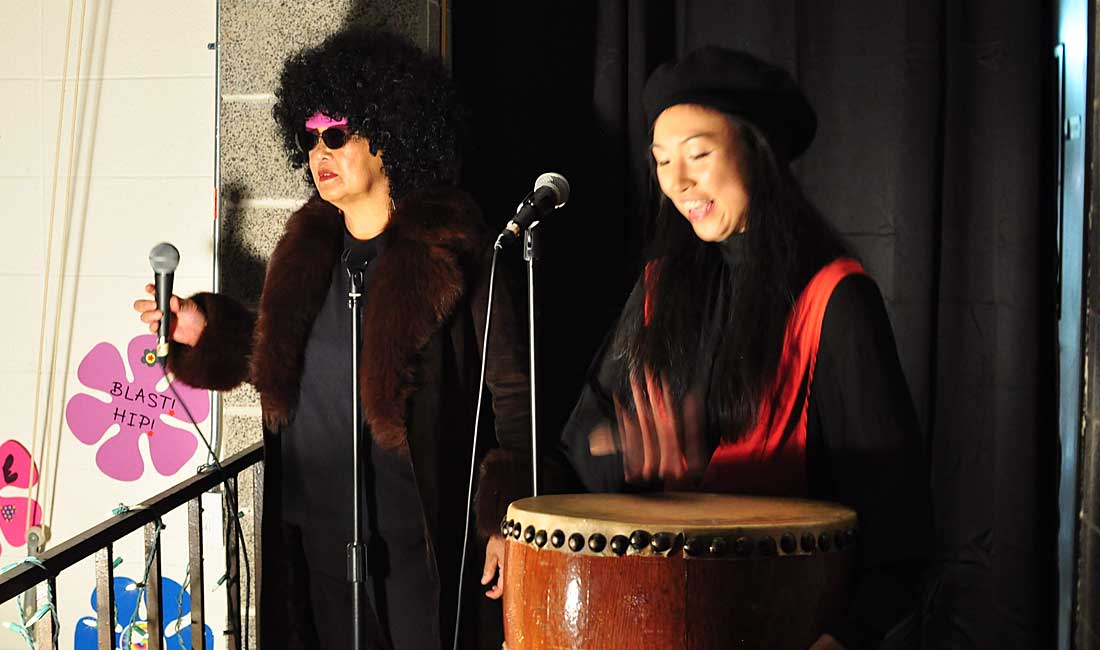
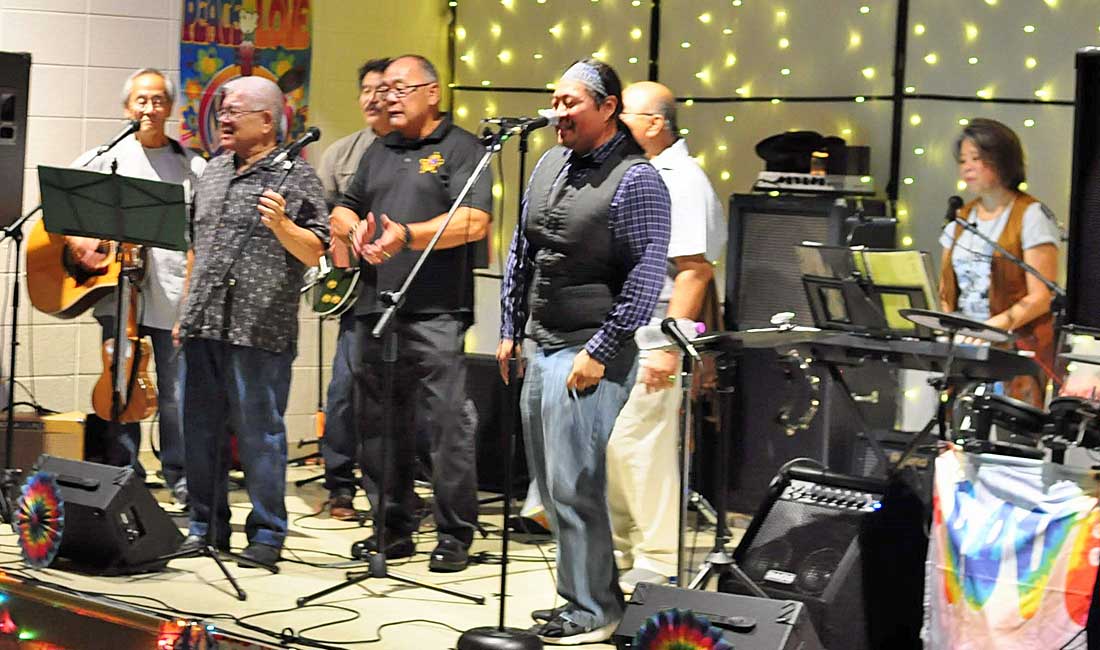
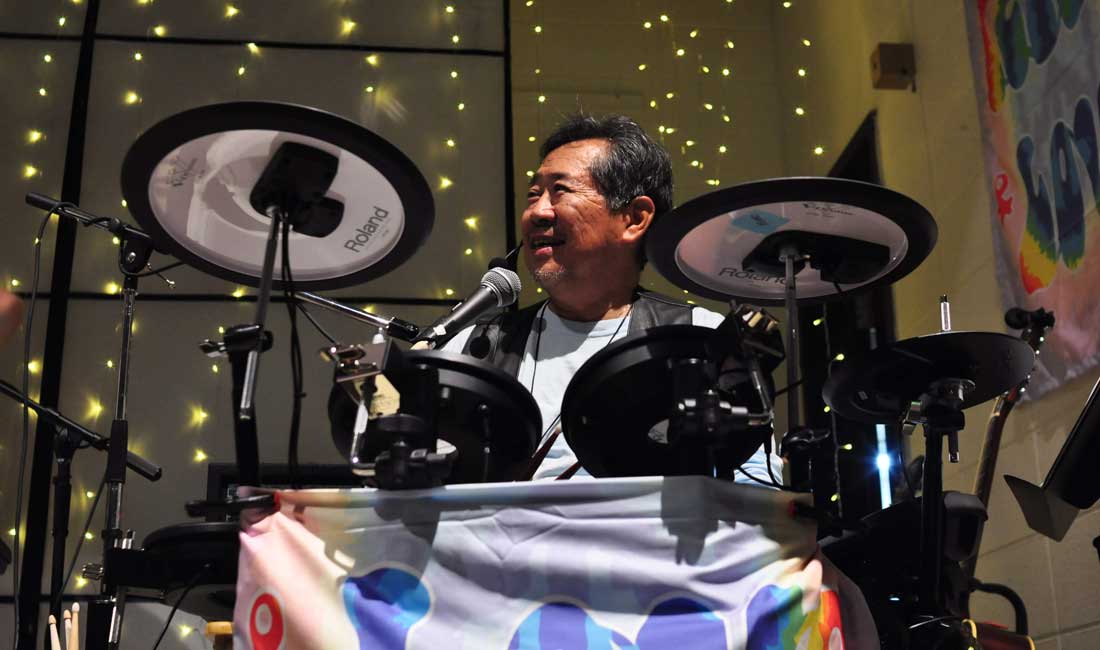
…a dark MBT dance hall with glimpses of psychedelic flowers and peace signs among strands of twinkle lights and the voice of Smokey Robinson filling the hall. Suddenly, lights hit Tonko Doi sporting a familiar afro saying: ”It is 1968 at MBC [Midwest Buddhist Church]…” However this time around, the dance-goers in the crowd are no longer just Sansei, but joined by multiple generations and races.

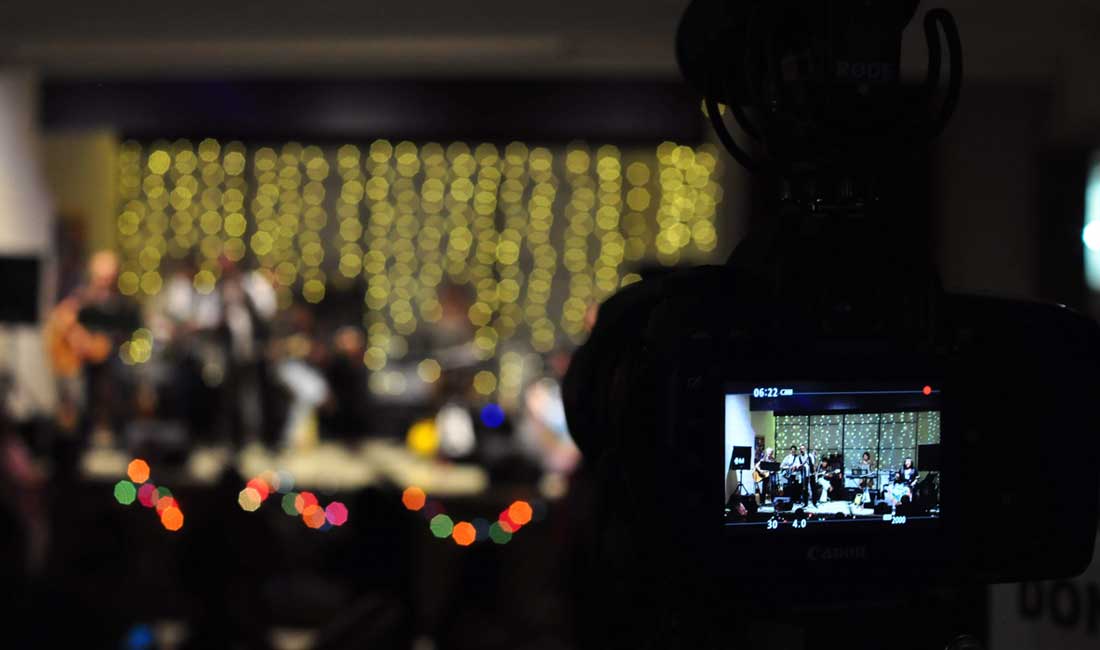
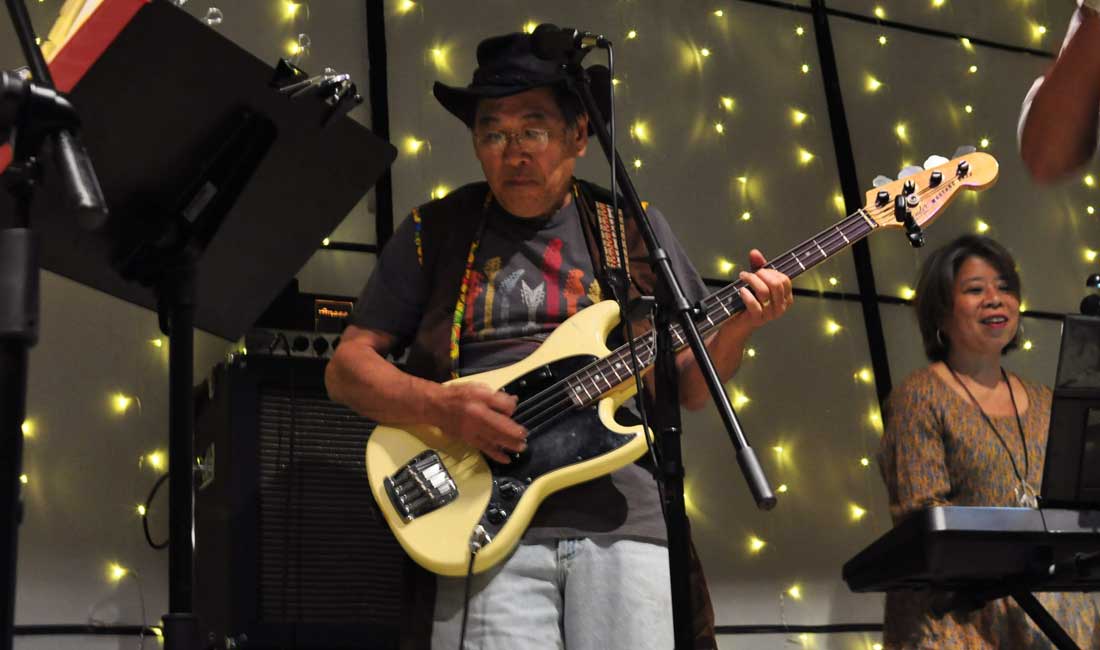
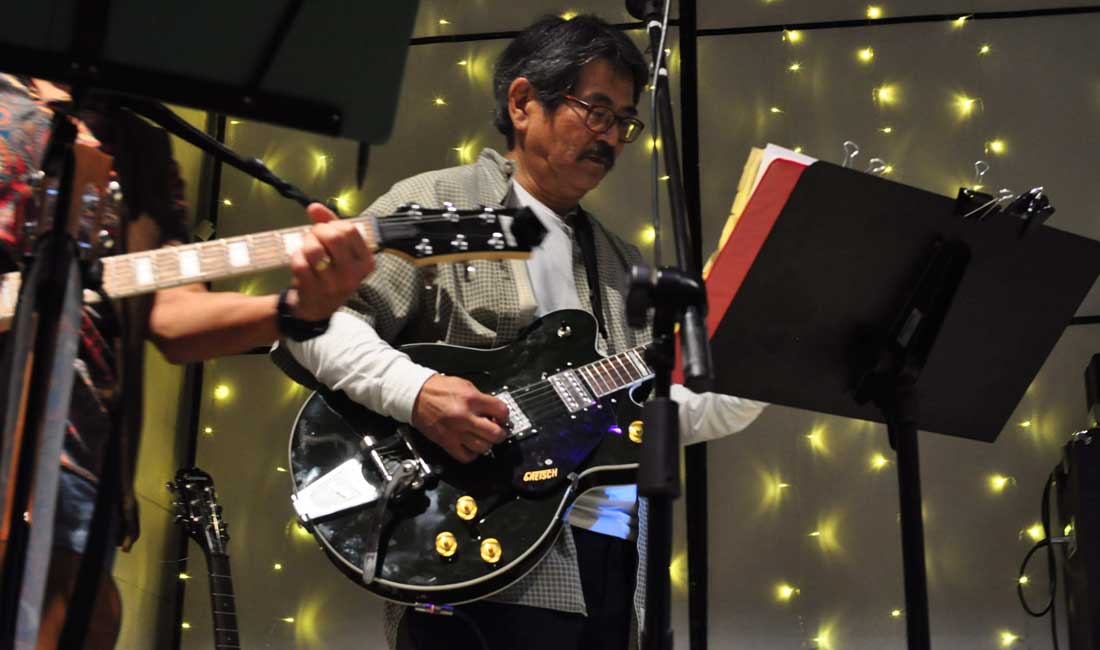
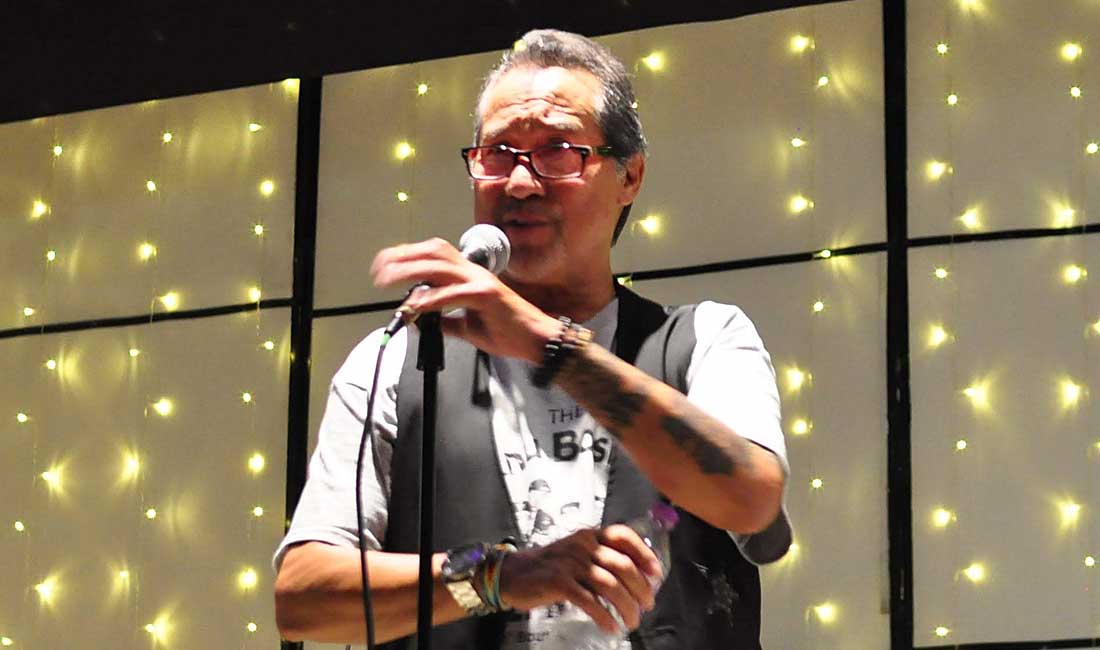
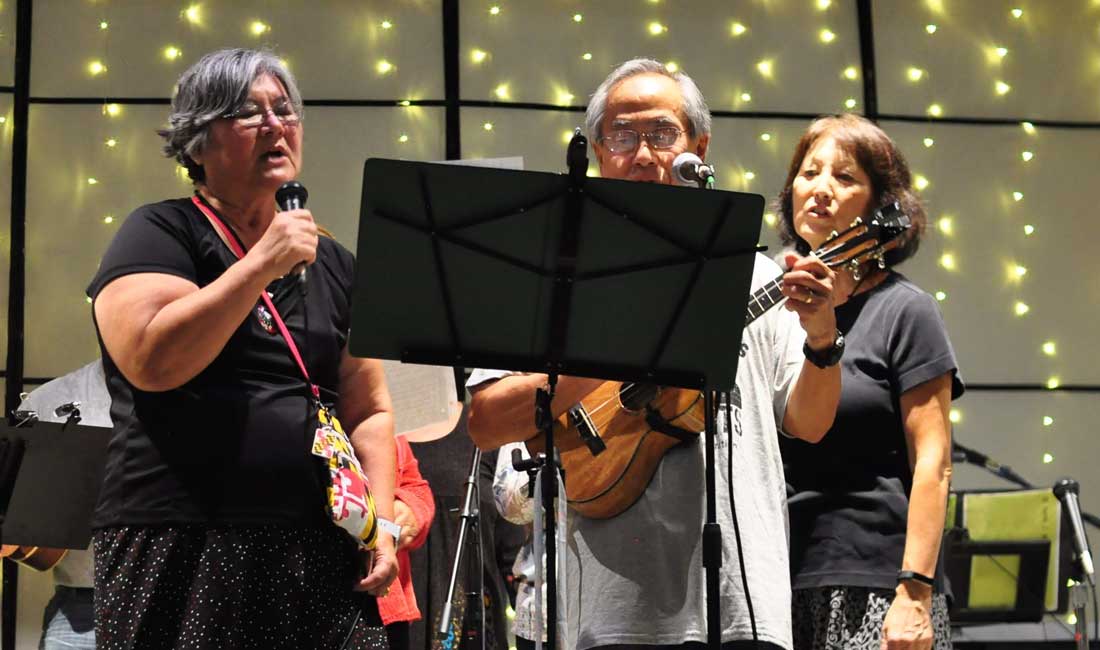
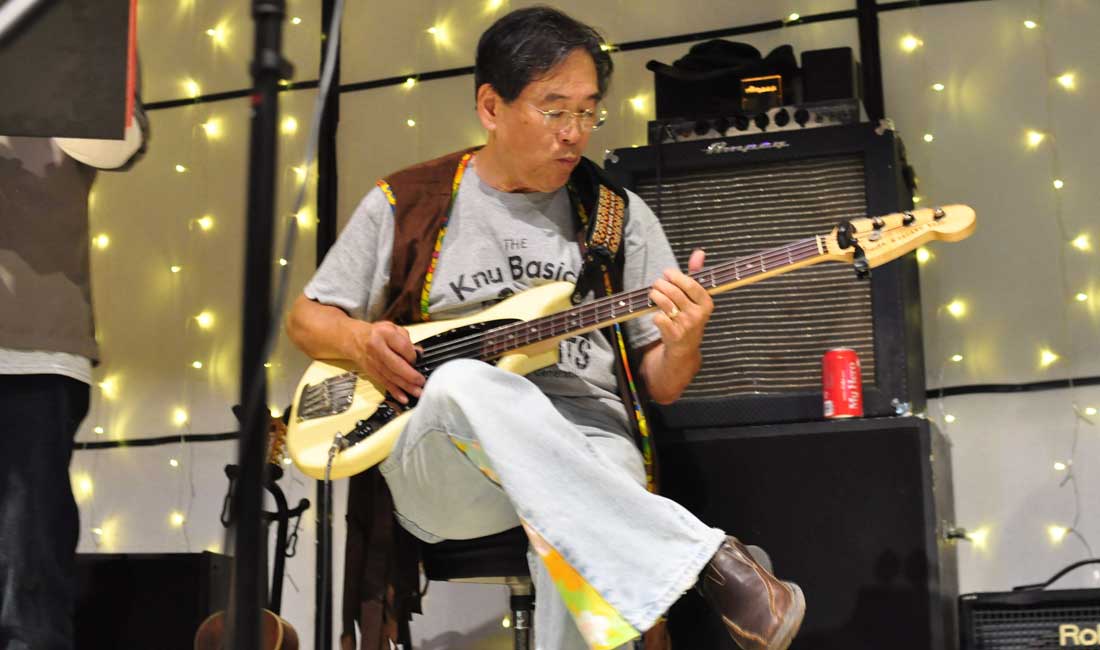
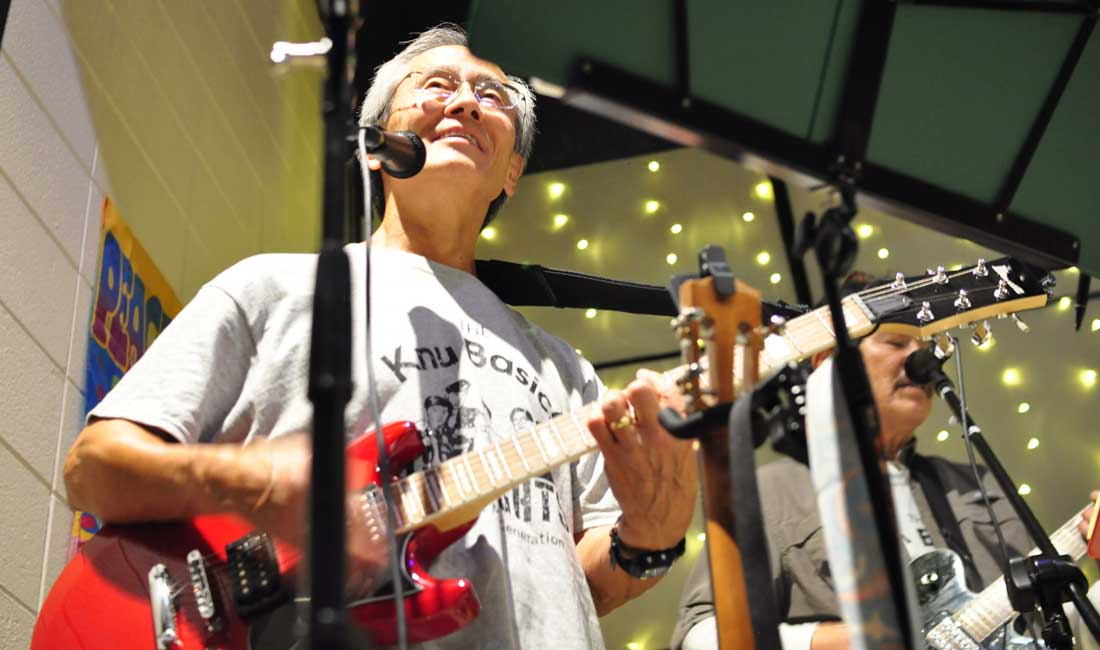
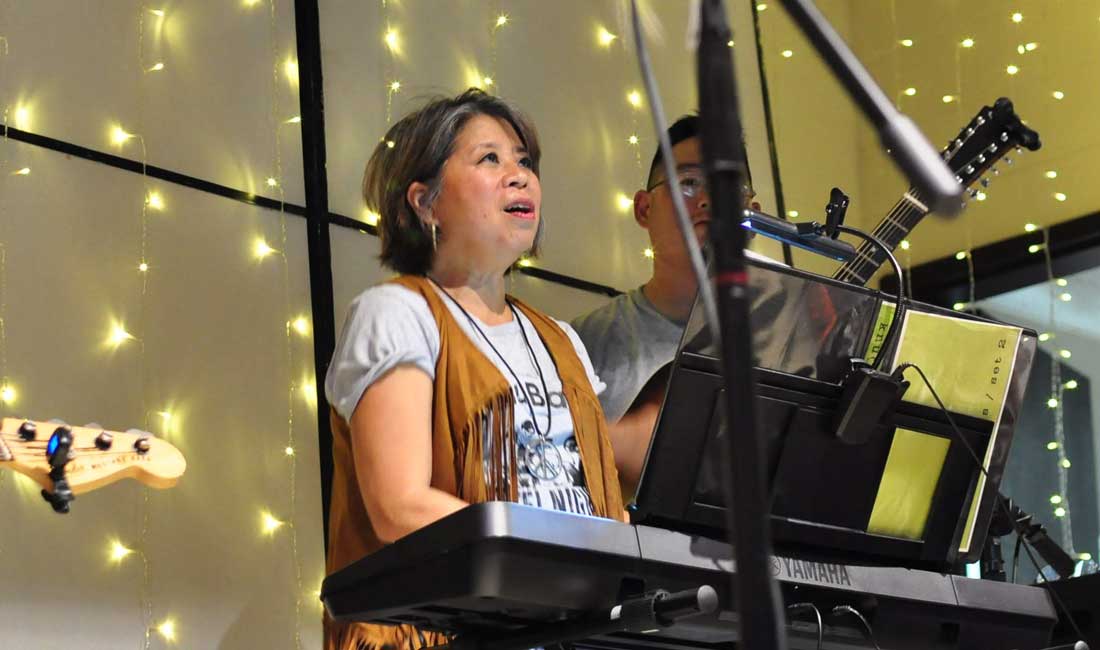
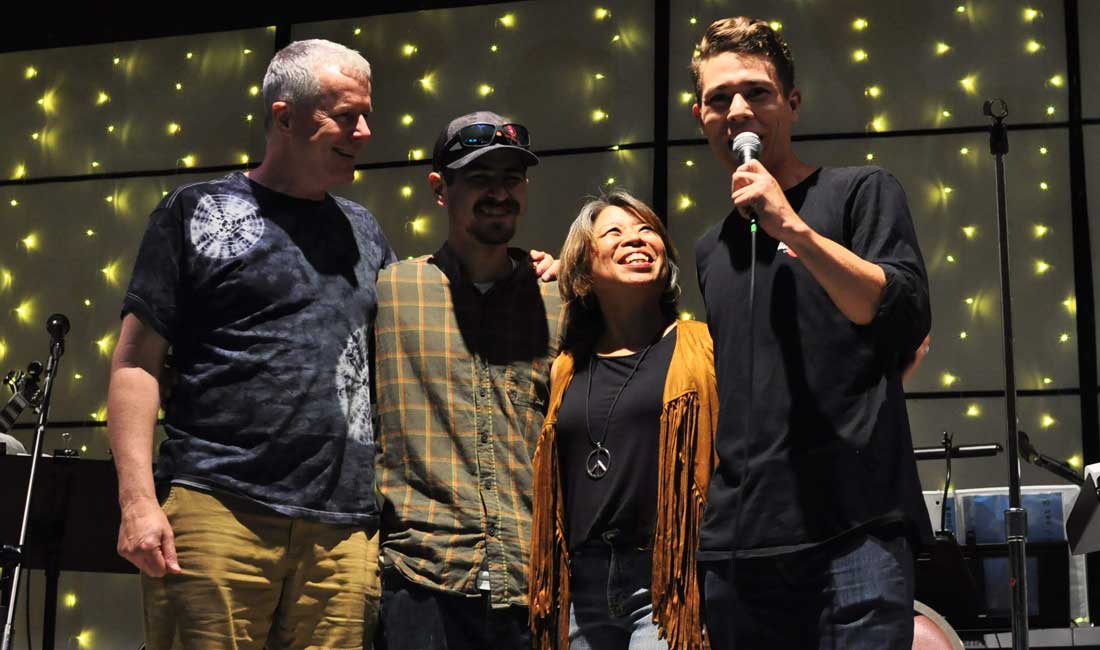
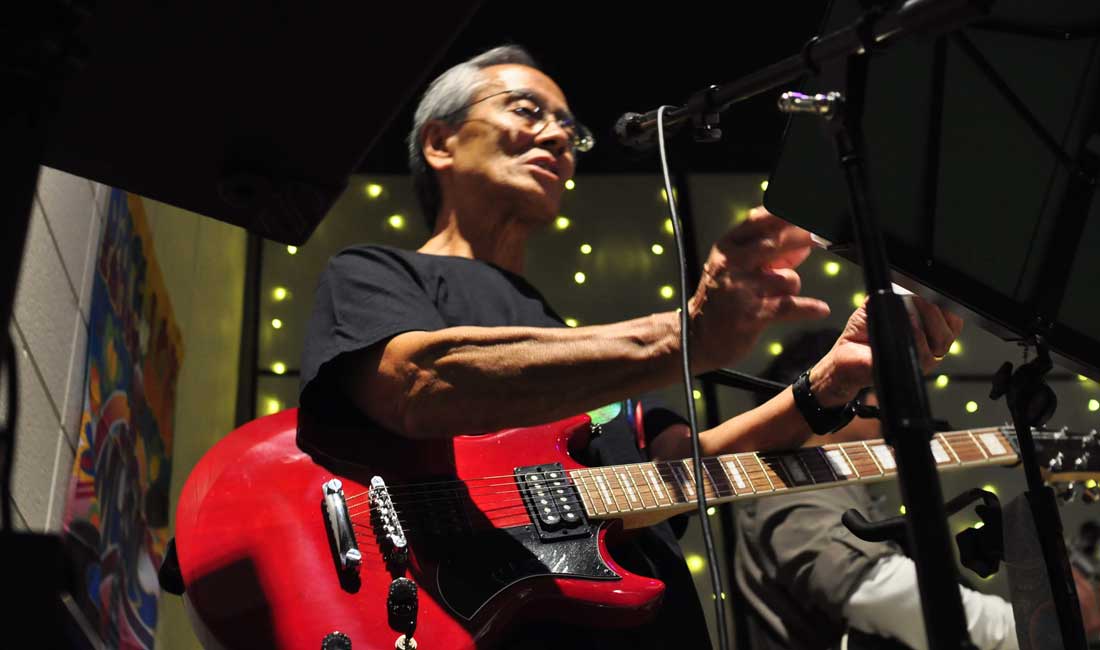
The sold-out evening, titled “Nikkei Nights; Talkin’ ‘Bout My Generations,” featured the reunion of the Knu(er) Basic, formally known as Knu Basic, which was made up by our own Steve Arima (on drums), Jim Chikaraishi (bass) and Elaine Matsushita (keyboard), as well as original band member George Formoso (lead vocals) and Darrell Kaneshiro (rhythm guitar) and Alan Arima (lead guitar). The band played three sets throughout the evening. They worked hard for the event, practicing eight hours per weekend leading up to the big night, with George driving nearly four hours each way from Michigan to get there.

He was not the only one traveling for the event. The performance also brought the whole Chikaraishi gang together, as well as two fans —friends and Chicago natives Naomi (Shimomura) Kawahara and Barbara (Kurokawa) Yamadera—from California and other groupies across the Chicagoland region.

The band played classic ’60s songs, including Steve’s trademark “Last Kiss,” and the never-ending “Shout.” One memorable moment was when the band invited special “voice of the angels” guests on stage—including Ryan Toguri on lead with David Toguri, Mike Naito and Al Shimizu singing backup on “My Girl.” David later remarked that they didn’t get to rehearse it, but when Ryan jumped on vocals, he wasn’t going to argue.

Also in the crowd was Fumiko Matsushita and Yayeko Adachi, as Elaine Matsushita and her then-fiance Bob Sutter were recognized by the band and her sons Josh and Sam Fidler for their wedding that would follow the next day.

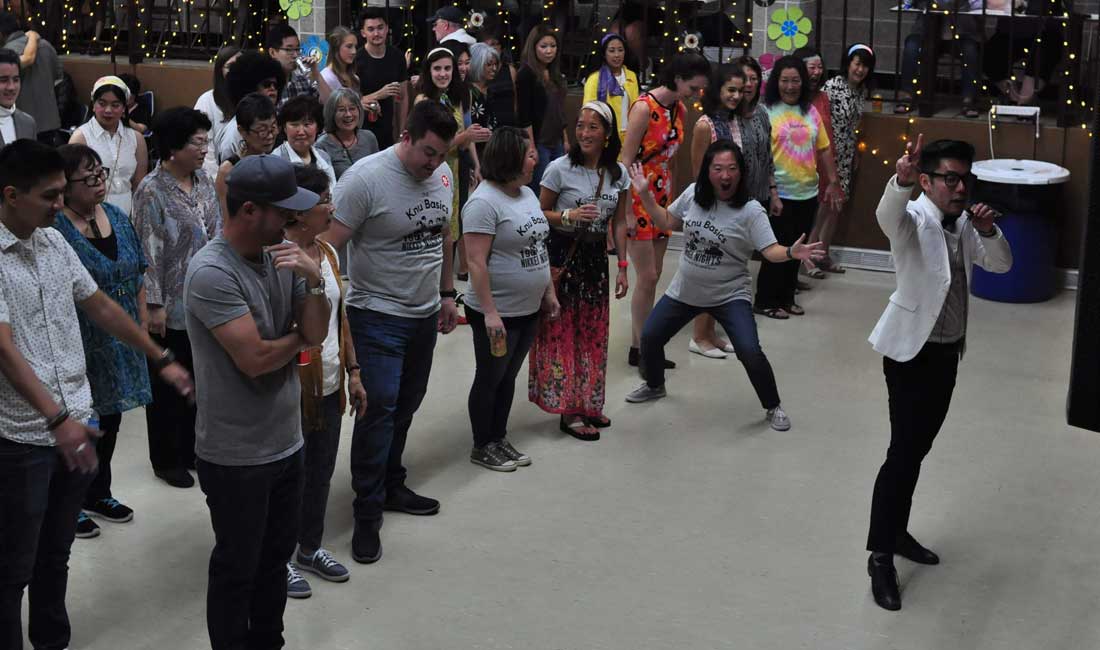
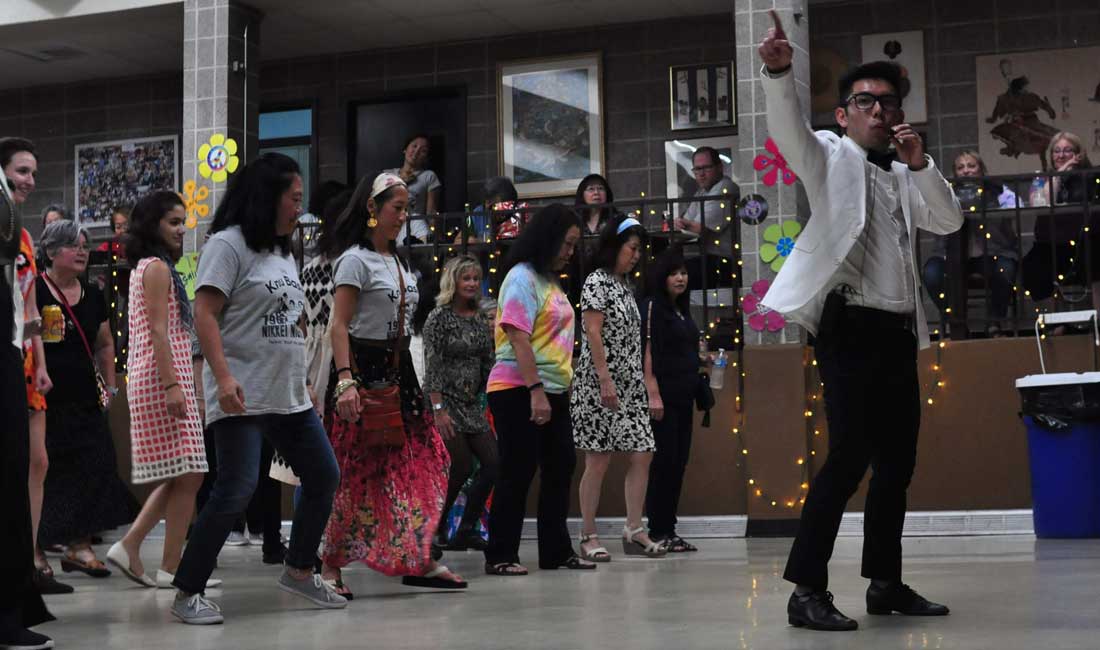
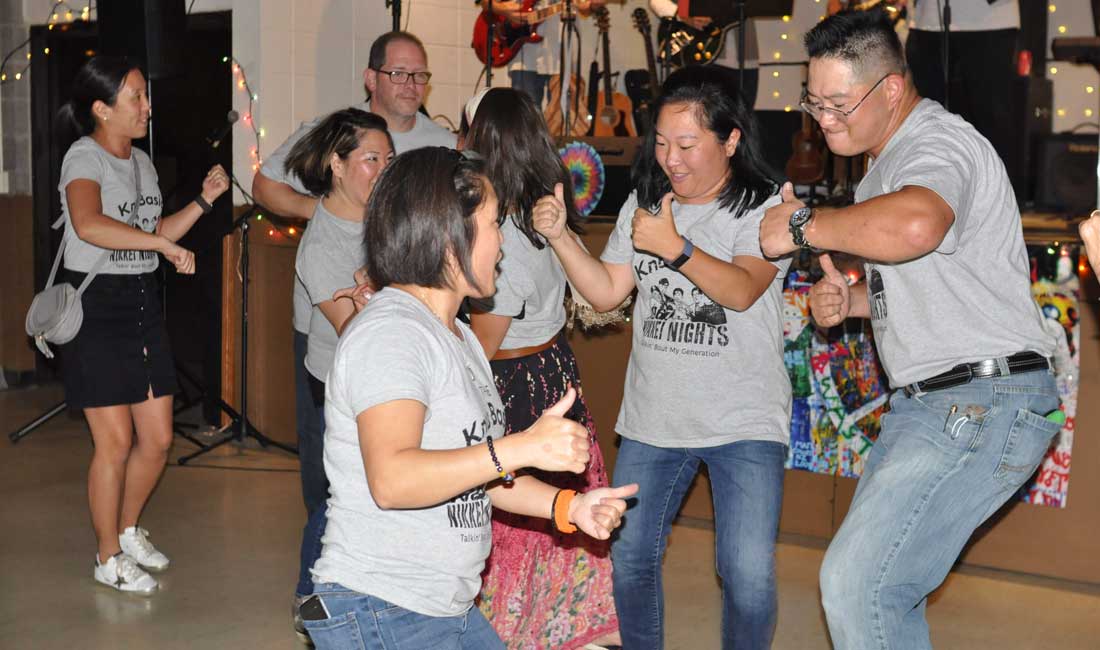
Yonsei also led the evening with entertainment throughout intermissions. Brandon Ishikata, a JACL Kakehashi Program alumnus, led line dancing that got the whole floor moving to Earth, Wind & Fire’s song “September” to fit the occasion (the song appropriately begins “Do you remember, the 21st night of September?” and the event was held on Sept. 21). Brandon professionally teaches dance at “May I Have This Dance” studio (mayihavethisdance.com) in Jefferson Park.

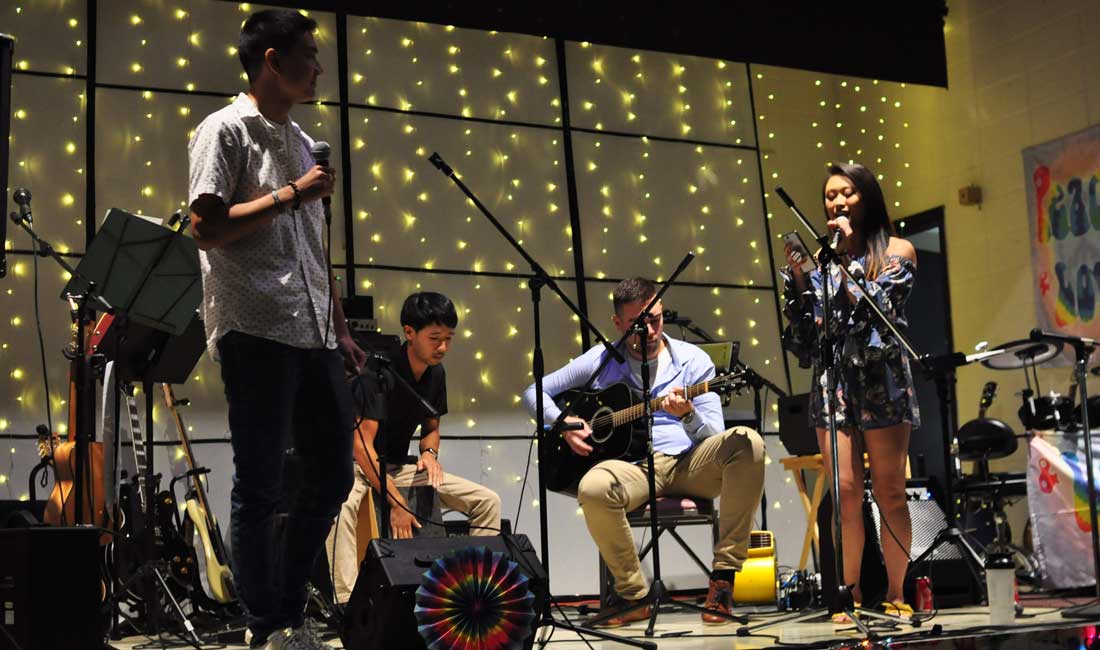
Also performing during one of the night’s breaks was the ensemble “Friends of 94,” featuring JACL board member Lane Mita, as well as Mas Hoshii, Joey Rolla and Elizabeth Mangulabnan. All had performed separately during the Open Mic Night last June during the MBT’s 75th Anniversary event “Contested Histories.” Despite not living during the times, they brought the crowd back to the ’60s grooves of Stevie Wonder and “Sukiyaki.”

Outside of the performances, crowds of different generations came together and shared memories of the Knu Basic performances back in the ’60s and ’70s at Viking Hall and Battle of the Bands in Chinatown, as well as some of the other bands that used to also gig around town back then.

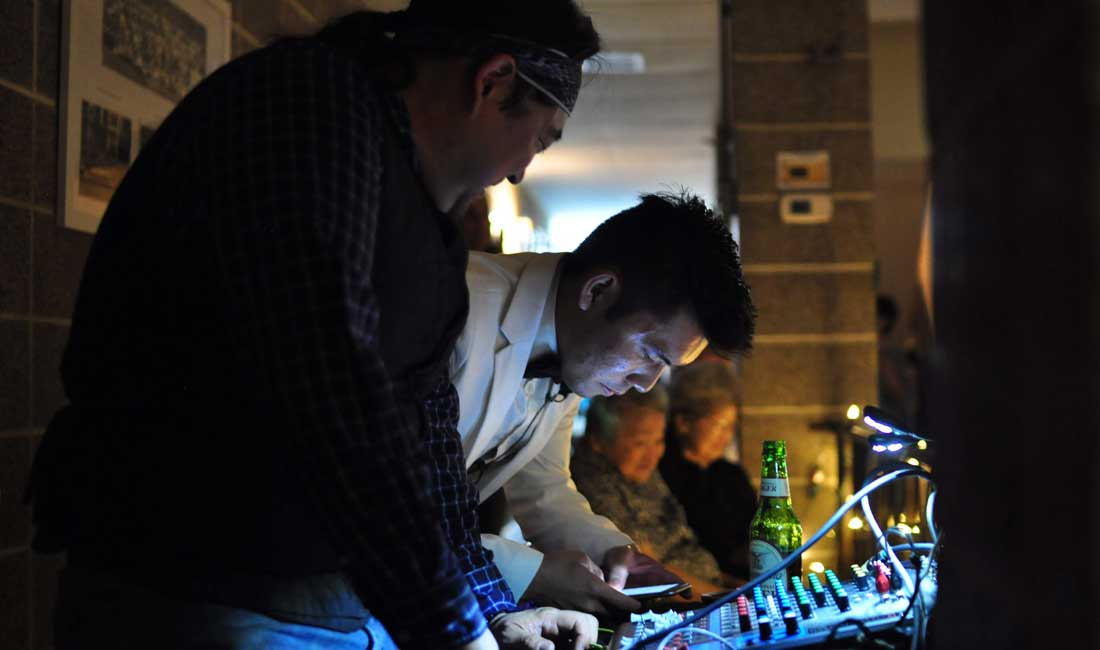
While the conversations happened in the Social Hall, Anna Takada, Kat Nakagawa and Jason Matsumoto were busy gathering interviews to capture not just the stories, but also the memories being made that evening. Some of these footages will be going toward JASC’s archives.

As a personal shout out, thank you to the Dance Committee’s co-chair Elaine Ogawa and committee members Steve Arima, Jason Matsumoto, Lisa Doi, Gary and Lynn Yamagiwa, Tonko Doi, Rich Taura and Gail Chase; and to all of the volunteers from MBT and JACL-Chicago. Together, we raised over $4,000 that will be divided between the MBT 75th Anniversary fund and JACL Chicago youth groups. Outta sight.

by EMILY HARADA (reprinted from MBT Bulletin Oct 2019)

FINDING HOME

May 17-19, 2019

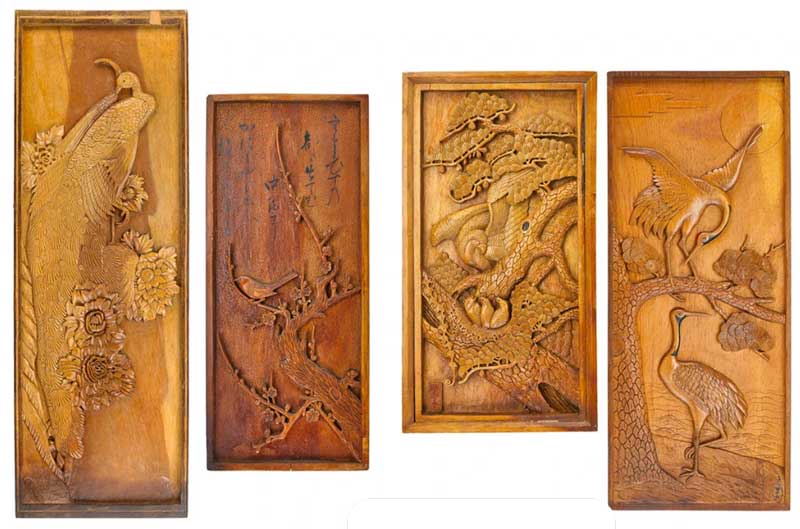
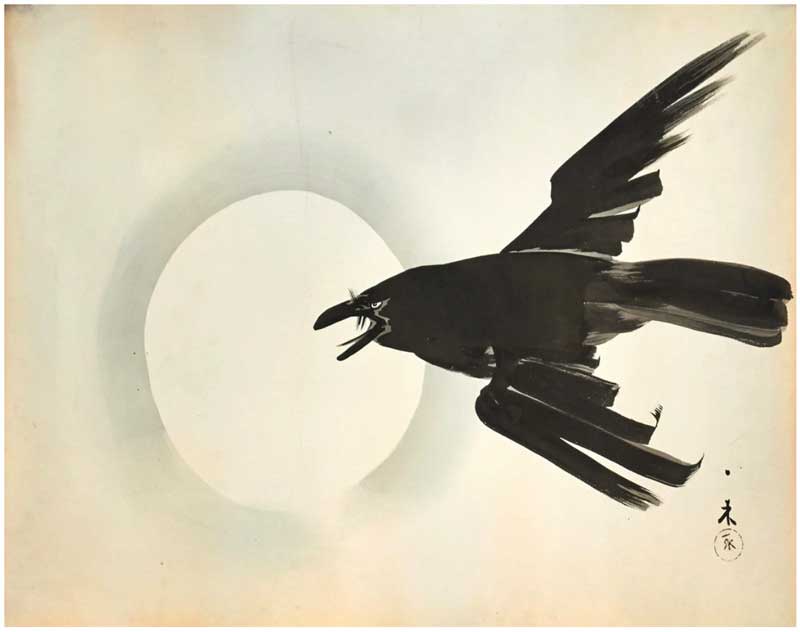
As part of our 75th anniversary MBT was honored with a special visit from Los Angeles’ Japanese American National Museum (“JANM”). Key museum staff were in Chicago Friday May 17th to Sunday May 19th to present CONTESTED HISTORIES, the museum’s traveling exhibit that displays never-before-seen art-and-craft objects created by Japanese Americans incarcerated during WWII.

With this special opportunity to host CONTESTED HISTORIES in Chicago, JANM staff and Chicago community leadership collaborated to offer a series of programs to reflect, discuss, learn and process this part of our history. These programs, collectively entitled FINDING HOME (Re)Building a community in the Second City, took place during the exhibit of CONTESTED HISTORIES and here we provide a summary of three events:

CONTEST HISTORIES exhibit and discussions

Sharing Stories: Intergenerational Conversations

Stage reading of “Garage Door Opener”

CONTESTED
HISTORIES

Sample artifact

Contested Histories: Art and Artifacts from the Allen Hendershott Eaton Collection came to the Midwest Buddhist Temple on May 18 and 19 as part of the temple’s 75th anniversary celebrations.

The traveling exhibit features art-and-craft objects and other handmade items created by individuals of Japanese descent who were wrongfully

Sample artifact

incarcerated in American concentration camps during World War II. These items were collected by Mr. Eaton while he was researching his book “Beauty Behind Barbed Wire: The Arts of the Japanese in Our War Relocation Camps” (1952).

Sample artifact

After being kept in storage for many years, the collection was saved from being dispersed by auction in 2015 by Japanese American community leaders and activists. Ultimately, the collection was transferred to JANM. For more information, visit janm.org/exhibits/contested-histories/
This is the first time this exhibit will be shown in the Midwest.

by Joyce Morimoto (from MBT Bulletin April 2019)

INTERGENERATIONAL
CONVERSATIONS

As its name suggests “Sharing Stories: Intergenerational Conversations”  brought together old and young in meaningful conversations about experiences, memories and the impact that the incarceration of Japanese Americans had upon those who lived through it and the generations that followed. Some excerpts from the conversations:

…One thing that I hadn’t thought about much but that came up often from the people who were young children in the incarceration camps was the struggle to find housing after coming to Chicago. It’s not an issue that I think of as specifically affecting Japanese Americans in Chicago today, but it was a common struggle for our community not long ago.

…Many Sansei and Yonsei who came to the event explained that they were seeking their family history that they were unable to hear from their parents and grandparents.

…Across generations, shame and silence was a common theme shared by the Issei and older Nisei participants, as it was a difficult and ostracizing time. Still, one Nisei remarked, “Regardless, I’m proud to be Japanese American.”

…A common conclusion among the participants was their heightened awareness of the generational impact of the incarceration—with trauma that experienced by incarcerees being passed down to their children.

…Maybe we are stepping in the right direction, though, as the younger generations are finding the voice that those who lived through EO 9066 could not find, and giving those who lived through it an opportunity to tell their story.

GARAGE DOOR OPENER
stage reading

(pictured above: the cast – Diana Lee, Dwight Sora, Aurora Adachi-Winter, Anne Shimojima and Ron Wesley—with ‘Garage Door Opener’ playwright Soji Kashiwagi)

The stage reading of Soji Kashiwagi’s “Garage Door Opener,” performed at MBT as part of the temple’s “Contested Histories: Finding Home” weekend, effectively employed humor to delve deeply into the pain and dysfunction between the Nisei and their children. The performance was given by five local actors—Dwight Sora, Anne Shimojima, Aurora Adachi-Winter, Roy Wesley and Diana Lee.

The garage filled with kamaboko boards, broccoli rubber bands and tofu containers came to represent all the emotions, conflicts and resentment that some Sansei carry with them. Through the discovery of other memorabilia by Glen and Sharon, the adult children gain a wider perspective and a deeper understanding of the trauma their Nisei parents experienced through their incarceration.

The discovery of their father’s valedictorian speech on citizenship, which sang praises of this great country, stood in stark contrast to the rounding up of Japanese Americans and being thrown into forced confinement in horse stalls and barracks. (read full article by clicking button)

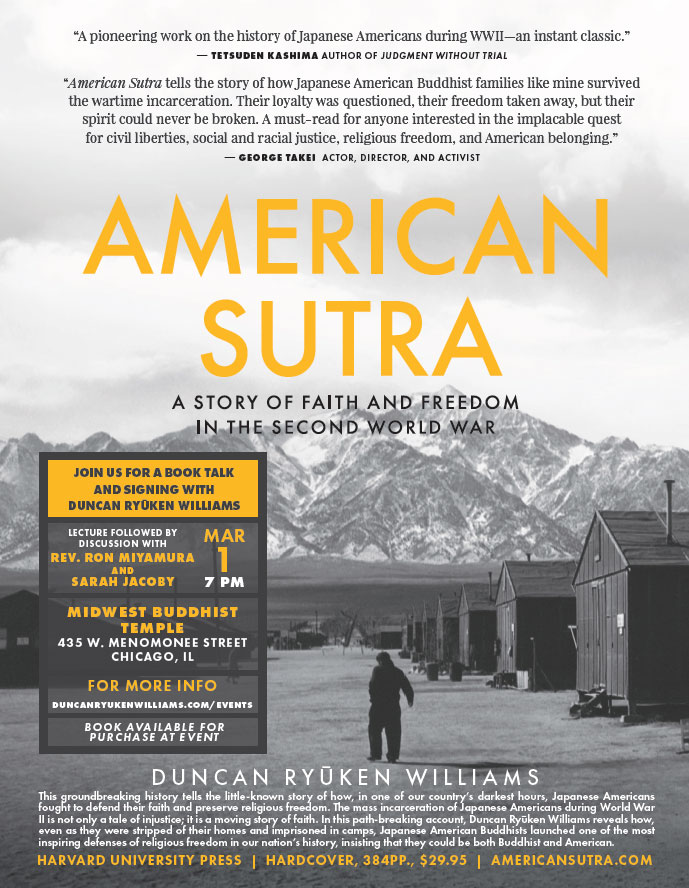
‘AMERICAN SUTRA’ book launch

March 1, 2019

AMERICAN SUTRA – presentation

FRIDAY MARCH 1 USC professor Duncan Ryukan Williams, who is also a Soto Zen priest and author of the book “American Sutra: A Story of Faith and Freedom in the Second World War” gave a presentation and talk about “American Sutra.” The book, released by the Harvard Press on Feb. 19, reflects on how Japanese American Buddhists dealt with dislocation, loss and uncertainty during their wartime incarceration.

Drawing on contemplative practices and rituals from their Buddhist tradition, their stories represent timeless approaches to finding inner liberation when freedom has been taken away from you. Their stories also represent a vigorous defense of the American ideal of religious freedom.

Dr. Williams was joined by Rev. Ron Miyamura and Northwestern University’s Associate Professor of Religious Studies Sarah Jacoby for a thought provoking discussion.

May 11th, 2020|

Are there naturally evil people?

Q-60pxWhat does Buddhism say about impure thoughts and immoral impulses? In other religions it is looked at as temptation from evil spirits and such, but how does Buddhism explain the root cause behind the temptation of sin and what can be done to help ourselves when tempted?

Is there such a thing as a naturally evil person?

A-60pxSecond question first: In Shin Buddhism (but not all schools of Buddhism), there is no such thing as a naturally evil person. Everyone is evil, so it is only a matter of degree.

Impure thoughts and immoral impulses—an interesting question. Certainly from a Buddhist point of view, this is not “sin” since there is no sin in Buddhism (sin as understood as breaking commandants or rules).

The bottom line is “we are responsible for our thoughts, words and actions” thus, we have to use our judgment, knowledge, wisdom and experience to handle any thoughts (pure or impure) we might have, and then decide what words and/or actions we will use.

Also, as Buddhists, we cannot judge other people’s actions (being non-judgemental), and we cannot know the whole situation. We can only judge ourselves and use our tools (judgment, knowledge, wisdom and exerpience) to determine our thoughts and then, maybe, our actions. Thus, our course of action, when “being tempted,” is to take responsibility for our actions.

Gassho (with palms together), Rev. Ron

April 18th, 2020|

Where is the justice?

Q-60pxWhy does Belle Knox get to make pornographic videos to pay for her Duke education and other people like myself take FAFSA student loan debt with interest
and have to do honest work to repay?

Where is the justice?

A-60pxAs a Buddhist, we cannot control what others do— nor can we judge them.

Belle Knox saw an opportunity to pay for college and took it. It is not the common way to pay for college, but it was her choice. As for most students, loans are about the only way to finish college.

For sure, there is no justice and there is no fairness. I certainly worry for this country and this world if it becomes the haves and have-nots.

For a more ideal justice, go back to the California Plan for Higher Education from the 1950s and 1960s—all community colleges, state colleges (24 campuses) and the University of California (10 campuses) had no tuition….every high school senior who was in the top 10 percent of the class could attend one of the U of C campuses.

This meant that a summer job could just about pay for dorm and books (and your parents would help at a reasonable cost).

It created great equality and diversity because money was the major determining factor of attending college or not. (Of course, then-Gov. Ronald Reagan started tuition in 1969, and the rest is history.)

So, the real justice is for you and your generation to make the changes in state government so that state colleges and universities could be tuition-free and could harbor real equal opportunity.

Gassho (with palms together), Rev. Ron

March 18th, 2020|

How do I become a Shin Buddhist?

Q-60pxDo I need to go through a formal ceremony in order to take refuge or is this “informal” in Shin Buddhism?

A-60pxThere is no requirements or initiation ceremony to be a Shin Buddhist, just come as you are and be part of our Sangha (that is, to be a part of the group of “fellow travelers”).

To be a member of the Midwest Buddhist Temple, one only needs to make a financial “pledge” (fill out the Pledge Form). From time to time, we do have a ceremony conducted by the bishop of the Buddhist Churches of America (our national organization) in which one receives a Buddhist name and pledges to follow the Three Treasures—the Buddha, the Dharma (the Teaching) and the Sangha. But this is optional.

Gassho (with palms together), Rev. Ron

February 28th, 2020|

Who can offer comfort?

Q-60pxWho offers comfort to a person who is grieving but cannot be comforted though he himself has already achieved enlightenment?

Is there ONE higher being that is acknowledged as a creator that can bring that comfort through Buddhism?

A-60pxNo, giving and receiving comfort is part of the workings of Compassion.There is not a higher being deciding what comfort means.

Buddhism is all about living, appreciating life because we realize that life is limited (i.e., death will come to each of us).

And achieving Enlightenment does not make one super-human, rather it makes one more human. Anyone who thinks or believes “I am Enlightened” is certainly not, because it would be an expression of the Ego-Self (the “I”).

Receiving comfort is like receiving food. We should appreciate and acknowledge the efforts of others (other people and all the things like sun, rain, soil, etc.). And remember that offering comfort requires someone to receive it. If the other person does not accept it, the comfort is meaningless.

It is like asking a blind man to see the sun and the clouds. We have to find ways so that a blind man can understand what sunshine is and what a cloud is.

Gassho (with palms together), Rev. Ron

January 23rd, 2020|

Sending a meditation of loving kindness

Q-60pxMay I please request you say a prayer so my health and finances improve?

A-60pxAs Shin Buddhists, we do not practice petitionary prayer, as such. The reason is that our founder warned us about asking for temporary things, and we really
should be concerning ourselves with what is important—for example, our spiritual well-being.

We can and do, however, send you our meditation on loving kindness.

Metta

May all beings be happy. May they be joyous and live in safety.

All living beings, whether weak or strong, in high or middle or low realms of existence, small or great, visible or invisible, near or far, born or to be born, may all beings be happy.

—From the Karaniyametta Sutra

Gassho
(with palms together),
Rev. Ron

October 24th, 2019|

A lesson from the big screen

Q-60pxHave you seen a movie lately (say in the last five years!) that made you think: Why, there’s a good Buddhist lesson there! If so, what was the movie and what was the lesson?

A-60pxI am not a movie person, and have not seen any recent movies. That being said, the movie that most moved me is a classic 1950 movie called “Rashomon.” It has the Buddhist lesson of “Right Views.”

Of course, this is a classic Akira Kurosawa movie starring a young Toshio Mifune and all that. In this movie, there are four versions of an event, a person’s death, a Samurai warrior.

The lesson is that we don’t really know what happened, but each person has their own version of what happened. So, we are left to wonder who is telling the truth or if any of them are telling the truth or only their version.

This is a reminder that we have to be careful in judging others, and to question our own selfish motives. “Right Views” means things are what they are though we don’t all see them the same, and we have to realize how difficult it is to determine what really happened.

Gassho (with palms together),
Rev. Ron

October 2nd, 2019|

Looking for statue for home altar

Q-60pxI am a new practitioner of Jodo Shinshu Buddhism from Florida, and I have a question. Unfortunately, there is no BCA-affiliated temple in my state. However, I’m interested in creating an altar in my home that includes a statue of Amida Buddha.

I’m wondering if you could please tell me if the statue seen here is Amida Buddha. Also can you please tell me the mudra this statue is holding?

A-60pxWelcome to Jodo Shinshu. You are right that we do not have a BCA temple in Florida. But it’s great that you want to create an altar for your home.

Yes, this is a statue of Amida Buddha. The mudra (hand position) is the modified “OK” sign (with thumb and index finger touching).

This statue is an Indian version of Amida. The look in Japanese art (via China) has made Amida look slightly different, and the official version of the Jodo Shinshu Hongwanji-ha (our mother temple in Japan) would say, the Amida statue should have 48 spokes radiating from the back of the head.

The BCA does not actually hold to that standard (we have temples with non-standard Amida statues, oh well). But what is important for you is that you like the statue. If you do, then please use it.

Gassho (with palms together),
Rev. Ron

August 22nd, 2019|

Helping others and one’s self

Q-60pxIn many areas of my life, I am the one people seem to feel comfortable confiding in or coming to for guidance; it seems I just have one of those faces. But at the end of the day, I can only be an expert on my own experience (and even then, who knows truly how self-aware I am).

How can one uplift others while maintaining balance within themselves? I imagine this might be a much smaller version of something a reverend might experience.

A-60pxYou are fortunate if people come to you for advice or guidance …and you are correct, we are all limited by our own experiences and judgment as I am sure you have already discovered.

People want someone to listen to them and your most important job is to really listen. The advice and guidance will come from within that person. The advice or guidance you offer can be vague. That is enough, if you have listened.

Gassho (with palms together),
Rev. Ron

June 1st, 2019|

What are Buddhist views on organ donations?

Q-60pxI am doing a presentation for my comparative religion class and I wanted to know your views on donating organs and donating the body to science?

A-60pxThe Shin Buddhist view on organ donations, like all decisions, it is up to myself (a personal decision) and each of us has to be responsible for those decisions.

That being said, organ donations are a personal decision. The human body is a vessel that is temporary and is not sacred, in and of itself (thus most Buddhists have their bodies cremated).

How we use and care of our bodies while we are alive is up to each of us. How and why organs may or may not be donated is just as important as the decision itself.

In short, there is no Buddhist point of view on organ donations.

April 24th, 2019|

Can Christian faith and Buddhism practice coexist?

Q-60pxI was raised Catholic and grew up on the South Side of Chicago. Although I do believe in Jesus Christ and the Creator, I feel that’s where my common beliefs end when it comes to the Catholic faith. I feel my beliefs are more in line with the Buddhist faith than any other religion.

I don’t know if someone like myself would be welcome in your temple but I would be interested in checking it out if an invitation were extended.


A-60pxYou are always welcome. While you may have seen our website, which has a lot of information, you also need to experience Buddhism.

We are an American Buddhist temple with roots in Japanese Shin Buddhism. We are a group of ordinary people (not monks and nuns). Our services are on Sunday mornings (an American adaptation) at 10:30 am and are open to everyone. In particular, we have no dogma and we have no requirements—come as you are. That is to say, you do not have to renounce your prior beliefs in order to attend our services and activities. Actually, the beliefs are subtle and personal.

In short, you don’t need an invitation. You are always welcome.

April 7th, 2019|

Observances of Buddhist holidays at MBT

Q-60pxPlease tell me when Vesak is celebrated here. I have found many dates for various countries but have been unable to determine which date applies to Japan. Are there special observances of the holiday at MBT?


A-60pxThe Midwest Buddhist Temple does not observe such. Vesak is pretty much a Theravada holiday, which celebrates the Buddha’s birth, death and Enlightenment (usually in May, but the date moves with the lunar calendar).

In the Mahayana tradition—and this means pretty much all of the Japanese schools of Buddhism—these three events are celebrated as three different holidays.

The Midwest Buddhist Temple (and the Jodo Shinshu Hongwanji, our mother temple in Japan) has converted to the western (solar) calendar, and celebrates the Buddha’s birth on April 8. This holiday is called Hanamatsuri (flower festival). The Buddha’s death is called Nirvana Day and observed on Feb. 15. Buddha’s Enlightenment is called Bodhi Day and marked on Dec. 8.

March 11th, 2019|

Can Christians become Buddhists?

Q-60pxI discovered Buddhism on a project I had to do back in school on world religions. I picked Buddhism and spiritualism. However ever since researching Buddhism, I’ve been wanting to become a Buddhist. Is it possible to join Buddhism after being baptized Christian? Can I become a Buddhist or is there proper steps to take?


A-60pxDepending on which school of Buddhism you choose to follow, there are different ways to get started… as for the Midwest Buddhist Temple and Shin Buddhism (our school of Pure Land Buddhism of the Jodo Shinshu Hongwanji), we have no requirements….we ask that you “come as you are….and stay awhile.”
Things from your past (such as being baptized) do not matter to us, and we know that each of us brings things from the past. But it is of no concern going forward.

I hope you can attend our services and participate in our activities.

Come as you are,

Gassho (with palms together), Rev. Ron

January 28th, 2019|

At Obon, we light the way for spirits’ return

Q-60pxWhy do we light candles at Obon in honor of loved ones who have passed? How did this tradition start?


A-60pxObon is traditionally the time to remember and honor loved ones. By legend, it is said that our loved ones come back from the land of the spirits to visit us and to “check up” on us to make sure that everyone has adjusted.

In Japan, the traditions of Obon are very local. In many parts of Japan, if there is a river or a lake, memorial boats made of paper with a candle are put into the water to light the ancestors on their journey back to the land of the spirits.

In Kyoto, there is a big festival and parade with floats and music. And as a finale, there are five mountains that have a bonfire with five different characters to light the path so that the ancestors can find their way back to the land of the spirits.

In California, where it does not rain during the summer, some temples write the name of a person who has passedon a short banner that is then hung from the chochin (the paper lanterns).

Here at the Midwest Buddhist Temple, we wanted to start a new, local tradition for us with some way to remember our ancestors. Using small cups with a candle seemed like something that would be possible, and then we decided to put a label with the person’s name.

And if we had a record, we would print their Homyo (Buddhist Name) on each cup. These candles are displayed on the balcony ledge during the Obon Odori (dancing) on Saturday, July 7, as well as during the Obon/Hatsu-Bon Service on Sunday.

If you are interested in having a memorial candle for Obon this year, please contact the MBT Office. We ask for a $10 donation for each name.

June 24th, 2018|

Deflecting Negative Energy

Q-60px What is the Buddhist way to handle when somebody publicly attacks you (verbally, (not physically)?


A-60pxAs always, when attacked, one should deflect that energy back to the person attacking.

When attacked verbally, the first reaction is no reaction. One must determine if the attack is even worth some kind of response; often the attack will look foolish if there is no reaction. There are times when a response is needed. At these times, the calm and quiet manner in which one responds is as important as the response itself.

After careful thought and consideration, the response should reply to the foolishness of the attack.

May 27th, 2018|

Let’s Learn from each other

Q-60px Why come to MBT?


A-60pxAt the Midwest Buddhist Temple, we encourage people to come as they are and stay a while.

As Shin Buddhists (Jodo Shinshu), there are no requirements to come to the temple and become a member. We would like to share the Dharma (Teaching) with everyone.

As Shin Buddhists, we don’t have a dogma (no set required beliefs), and we want everyone to be just the ordinary people that we all are.
As a Sangha (a group of “fellow travelers”), we learn from each other and we come to treasure some simple values: Profound Gratitude, Great Kindness and True Humility.

It is most interesting that these are values that cannot be taught as such. One can read about them, but it does not mean anything without the experience.

We learn these things by observation and by coming close to these experiences. For example, there are people who have turned sorrow and anger into gratitude when perhaps a young daughter passes away before the mother. The mother can transform that sorrow into gratitude for the few years her daughter shared (Profound Gratitude) … we know there are children as young as 8 years old who would use their allowance, without prompting, to purchase shampoo to donate to the Sarah’s Circle shelter (Great Kindness) … and there are people who can bury their ego and just say “thank you” for just a smile (True Humility).

These are things that come about only by being part of MBT. The organization allows the Sangha to be the vehicle to share the Dharma. We are “fellow travelers” on this path of life.

May 6th, 2018|

What to say when someone sneezes?

Q-60px Rev. Ron, what do you say to someone when they sneeze?


A-60pxThere are a variety of explanations for why people say “God bless you” or “bless you” when someone sneezes. Among them is the belief that it is said to prevent the devil from stealing your soul because it once was believed that a sneeze separates the soul from the body.

According to Wikipedia, National Geographic reports that during the plague of AD 590, “Pope Gregory I ordered unceasing prayer for divine intercession.

“Part of his command was that anyone sneezing be blessed immediately (‘God bless you’), since sneezing was often the first sign that someone was falling ill with the plague.” By AD 750, it became customary to say ‘God bless you’ as a response to one sneezing.
The other common response to a sneeze is “gesundheit,” which means to wish someone good health when they sneeze and hopefully to forestall the illness that the sneeze portends.
But these explanations don’t relate to any Buddhist beliefs or those in Asian cultures and, thus, as a Shin Buddhist, there is no need for a “blessing” when someone sneezes. But as an American, it is certainly appropriate to respond to a sneeze with a “bless you” or “gesundheit” out of cultural politeness—just realize that it is not a Buddhist thing.

April 1st, 2018|

The mystery of attaining enlightenment

Q-60px If a person reaches enlightenment, will she or he know it? And, if so, how will they know it? Will others?


A-60pxThis is a trick question . . .

Yes, each person will know (or sense) for him- or herself that things have changed, and one would sense a change in oneself. And it would be a very humbling experience. And the sense of self (i.e., the ego) will change.

We have to remember that full Enlightenment (Pari-Nirvana) will occur only after death. While one is alive, we can experience Enlightenment (reach Nirvana) in a limited way. One is still human, so one is still limited.

One does not know if one has reached Enlightenment, but it is more of a sensing that things have changed, and that that person has changed. There is no way to describe that experience; there are no words to express that experience; there is no lightbulb that suddenly goes on. There would be a sense that things have changed and, yet, nothing has changed.

Others will know, again, only by sensing it, feeling it, or somehow know to be in the presence of someone very special. The key characteristic would be a deep and profound humility. There is also a great sense of Oneness and peace.

But trying to describe something that is indescribable is fruitless. Each person is unique and thus each person’s Enlightenment is unique, which makes trying to describe this experience impossible.

Maybe, we should reverse it and remember that anyone saying “I am enlightened” is proof that they are not. As soon as that person says “I,” we know they have not let go of their ego.

January 24th, 2018|

Trio of books on Buddhist thought to take to a deserted island

Q-60pxIf you were stranded on a deserted island, what three books related to Buddhism or Buddhist thought would you want with you?


A-60pxThe three books that I would want to have when stranded on a deserted island would be:

1. “Ocean: An Introduction to JodoShinshu Buddhism in America”
2. “River of Fire, River of Water: An Introduction to the Pure Land Tradition of Shin Buddhism” and,
3. “Kyo Gyo Shin Sho,” the Ryukoku Translation Series.

First, the book “Ocean” by Rev. Dr. Ken Tanaka is my favorite book to remind myself of the basics of Shin Buddhism for just ordinary people like me. This book is filled with multiple layers of meaning and discusses topics in an easy-to-understand manner.

Second, the “River of Fire, River of Water” by Dr. Taitetsu Unno is really an explanation of Shinran’s thoughts in relatable situations. This book is also filled with multiple layers of meaning and looks at Shin Buddhism by an American scholar who has
studied deeply into Buddhism.

Third, this book is an unusual choice, but I would love to have time to read and re-read over and over the Ryukoku Translation
Series book which only takes part of Shinran’s own words (and not the long quotations which make up much of the master work).
This book is really to study and understand the depth of Shinran’s thoughts and takes a long time to linger in thought. Unfortunately, this book is out of print and thus not readily available.

December 4th, 2017|

Shinran’s teachings: And justice for all

Q-60pxIf Shinran were alive today and happened to be on the playing field (or basketball court or baseball diamond, you get the picture) as the National Anthem played, do you think he would take a knee? And can you please elaborate on your answer?


A-60pxShinran would probably take a knee; he was a radical in his own way. He was definitely not a political person, but he would be angered by the U.S. president trying to make political points at the expense of a racial minority.

Not standing for the National Anthem is not about disrespecting the flag and not about showing disrespect to the principles of democracy. Rather, it is about remembering that justice has not always been equally practiced.

He was definitely a person of the ordinary people and would have empathy with Black Lives Matter.

October 18th, 2017|

Am I meditating now?

Q-60pxWhat is meditation? And how do I know I’m doing it?


A-60pxMeditation, in the current context, has come to mean the physical discipline of sitting meditation and using techniques to focus the mind. Many people assume Buddhism means physical meditation.

In Mahayana Buddhism, meditation was a tool to allow one to lose the ego (our selfish image of myself) and to find Sunyata (emptiness). And in the traditional schools of Buddhism, meditation was any action that focused the mind (mindfulness).

Almost anything can be a meditation if we are mindful.

However, Buddhists have usually put a strict discipline with these actions. Flower arranging, tea ceremony and the martial arts are examples of how strict disciplines within our actions can lead to Enlightenment.

But for Shin Buddhists, the discipline of physical meditation is not needed. Rather, awareness and the sudden (crosswise transcendence) awakening is our path to Enlightenment. The entrusting heart needed to accept Wisdom and Compassion is a special kind of mindfulness (but we do not call it meditation).

July 30th, 2017|

What does Enlightenment really mean?

Q-60pxI know we strive to reach Enlightenment, but I’m not really sure what Enlightenment means? Is it seeking truth? And, if so, what is “truth” in terms of life?


A-60pxEnlightenment is really to discover Wisdom and Compassion. It is important to know that one discovers (finding what is already there) Enlightenment by understanding the universe. Wisdom is not intellect, but to understand things as they really are. Compassion is to accept the world equally, without discrimination.

There are many ways to understand Enlightenment: to accept change and interdependence, to go beyond human limitations and human ego (our selfish image of myself), to find “Truth.”
Finding Truth is equally vague because we do not know what Truth really is. And the more we try to define it, the more elusive it becomes. Truth in the Buddhist sense is to understand things as they really are.

Truth in terms of life is to drop our human baggage and to find the spiritual meaning that is beyond logic and beyond our physical world. It is to understand the whole universe and to accept our small part of the whole without human limitations and ego.

June 25th, 2017|

What does Buddhism say about guilt?

Q-60pxWhat do Buddhist teachingssay about feelings of guilt?


A-60pxGuilt is not really found in Buddhism. Buddhism teaches us to take responsibility for our thoughts, words and actions. If we make our decisions with the best of our abilities, then as long as we also take responsibility for those decisions, then there is no guilt.

Culturally, many Buddhists and especially Japanese Buddhists live in a society that is strongly biased by shame. One does not do things that bring shame to the family or to the village or to the group. Shame can function much like guilt, but one should know the difference.

May 28th, 2017|

Will I See You Again?

Q-60pxBuddhists sometimes talk about seeing someone who has passed again, or the deceased being with other loved ones who have passed. How does this thinking fit in with Buddhist teachings?

A-60pxTo personalize death and our seeing our loved ones after this earthly life is a common thought. There are all kinds of theories and writings on this topic.

The bottom line is that we do not know: No one has ever died, and come back to tell us what happens after human death. So, in the spirit of the Oneness of all Life, if we can take comfort in thinking that we will be reunited with loved ones after death, I guess, I cannot deny it.

The Oneness of all Life is the key teaching to understand. We are all interconnected and interdependent. Birth and death is all part of the Oneness.

April 21st, 2017|

Temple welcomes weddings for same-sex couples

Q-60pxCan a same-sex couple get married at the Midwest Buddhist Temple? 


A-60pxYes. It is not an issue. We certainly encourage all people who want to be married to have a ceremony at the temple.

The Midwest Buddhist Temple and the Buddhist Churches of America (BCA) have “allowed” same-sex weddings for a long time. From the 1950s to the present, there have been wedding ceremonies of same-sex couples even when same-sex marriages were not legal. For the most part, these early same-sex weddings were only ceremonies in the Buddhist tradition (and were not legal marriages), and they were kept quiet and private.

The BCA Ministers Association went on record and passed a resolution in support of gay marriage in 1998. As gay marriage has become legal in some states, the number of same-sex marriages has increased. Perhaps, the most publicized gay marriage held at BCA Temple was at the Los Angeles Betsuin with George Takei and Brad Altman.

March 22nd, 2017|

Ministers and lay people are all fellow travelers in journey of life

Q-60pxHow is life as a minister different than life as a practicing Buddhist?


A-60pxAs Shin Buddhists, there is not much difference between being a minister or lay person. The professional aspects of being a Resident Kaikyoshi (Minister), of course, have added responsibilities and duties to serve the members of the temple. But the core of appreciating the Buddha-Dharma is very much the same.

More recently, I have really come to appreciate the unique teachings of Shin Buddhism that allows “ordinary people” to discover Awakening. There is not a separation between monks and ordinary people since we are all fellow travelers.

February 22nd, 2017|

Life, death: Where do we go from here?

Q-60pxWhat are Buddhist beliefs of the moment a person dies? They pass from their earthly life to what?


A-60pxOne passes into the Pure Land. This is difficult to explain. Each Buddha lives in a home, as all people do, but his home is a “land” or more like a “realm” which is not a physical place. And, the largest Pure Land is the Home of Amida Buddha.

It was Shinran Shonin, our founder, who saw that everyone, with no exceptions, can enter Amida’s Pure Land and receive all the benefits of Awakening/Enlightenment. The idea of “no exceptions” is the meaning of Infinite Compassion (which is really difficult for humans to accept).Think of life as an ocean….this is the Oneness of life. In the ocean, there are waves that have a shape and form for a limited duration.

Our lives are like a wave, we have a shape and a form for a limited time; we think we are unique and separate (which would be our ego or image of ourself). When the wave hits the shore, it disappears….yet, we all know that the wave was always part of the ocean. Each wave comes from the ocean and returns to the ocean…this is Oneness.

So, where do we go ? We return to the Oneness of all life….the Pure Land is that Oneness of the ocean.

January 24th, 2017|

Do Buddhists believe in heaven and hell?

Q-60pxDo Buddhists believe in a heaven and hell?

A-60pxYes. And no…. No, Buddhists do not have a heaven or hell in the sense of something in the afterlife. There is no reward or punishment at the time of death.

Yes, Buddhists have the concept of the universe that we call Samsara which describes the world we live in and it refers to this life (not an afterlife).

There are Six Realms of Samsara. In each Realm, there are beings who dwell among:

  1. Heavenly Beings
  2. Human Beings
  3. Ashura (Fighting Spirits)
  4. Gaki (Hungry Ghosts)
  5. Animals
  6. Hells

These are the Realms that we are constantly migrating through in our present life. One moment, we are filled with goodness and dwell among the Heavenly Beings. The next moment, we may be angry and dwell among the Fighting Sprites.

Buddhism always has been concerned with this life. While we are alive, we have to seek Enlightenment. The Buddha taught that knowing where we came from or what happens after death should not take up any of our energy.

In the story of the Poison Arrow, the Buddha asked: If we were shot by a poison arrow, should we first find out who shot the arrow, what kind of feathers were used, how big the bow was, or all kinds of other facts about the shooting? No, the Buddha taught. The first thing to do would be to remove the arrow.

For us, in this life, while we are alive, the first thing is to remove ignorance and selfishness so that we can come to understand Wisdom and Compassion.

December 16th, 2014|
Go to Top